Physics
My Course
Learn
Exam Prep
AI Tutor
Study Guides
Textbook Solutions
Flashcards
Explore
My Course
Learn
Exam Prep
AI Tutor
Study Guides
Textbook Solutions
Flashcards
Explore
Back
LRC Circuits quiz
You can tap to flip the card.
Define:
What components make up an LRC circuit?
You can tap to flip the card.
👆
What components make up an LRC circuit?
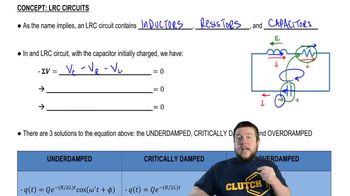
An LRC circuit consists of an inductor (L), a resistor (R), and a capacitor (C).
Track progress
Control buttons has been changed to "navigation" mode.
1/15
Related flashcards
Related practice
Recommended videos
LRC Circuits definitions
LRC Circuits
15 Terms
LRC Circuits
30. Induction and Inductance
3 problems
Topic

Patrick
LC Circuits
30. Induction and Inductance
3 problems
Topic
Patrick
30. Induction and Inductance - Part 1 of 2
5 topics
8 problems
Chapter
Patrick
30. Induction and Inductance - Part 2 of 2
6 topics
8 problems
Chapter
David-Paige
Guided course
09:40
LRC Circuits
Patrick
2640
views
5
rank
4
comments
Guided course
04:24
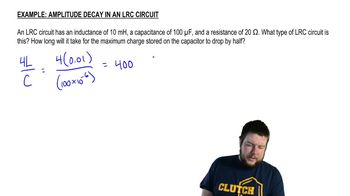
Amplitude Decay in an LRC Circuit
Patrick
1776
views
9
rank
3
comments
Terms in this set (15)
Hide definitions
What components make up an LRC circuit?
An LRC circuit consists of an inductor (L), a resistor (R), and a capacitor (C).
What is the voltage across the capacitor in an LRC circuit?
The voltage across the capacitor is given by Vc = Q/C, where Q is the charge on the capacitor.
How is the voltage across the resistor expressed in an LRC circuit?
The voltage across the resistor is Vr = IR, where I is the current and R is the resistance.
What is the expression for the voltage across the inductor in an LRC circuit?
The voltage across the inductor is VL = L(dI/dt), where L is the inductance and dI/dt is the rate of change of current.
How is the current related to the charge on the capacitor in an LRC circuit?
The current is I = -dQ/dt, indicating it is the negative rate of change of charge on the capacitor.
What type of mathematical equation describes the charge in an LRC circuit?
The charge is described by a second-order differential equation involving Q, dQ/dt, and d²Q/dt².
What are the three types of solutions to the LRC circuit's differential equation?
The three types are underdamped, critically damped, and overdamped solutions.
What characterizes the underdamped solution in an LRC circuit?
The underdamped solution shows oscillatory behavior with decreasing amplitude due to energy loss in the resistor.
When does an LRC circuit behave like an LC circuit?
It behaves like an LC circuit when the resistance is very small, making the inductive effects dominant.
What happens to the maximum charge on the capacitor in an underdamped LRC circuit over time?
The maximum charge decreases over time because the resistor dissipates energy from the circuit.
How does a critically damped LRC circuit behave?
A critically damped circuit returns to equilibrium without oscillating, resembling an RC circuit.
What is the behavior of an overdamped LRC circuit?
An overdamped circuit does not oscillate and also behaves similarly to an RC circuit, with a slow return to equilibrium.
How does increasing resistance affect the behavior of an LRC circuit?
Increasing resistance reduces the inductive effects, making the circuit behave more like an RC circuit.
How does the angular frequency of oscillations in an underdamped LRC circuit compare to that in an LC circuit?
The angular frequency in an underdamped LRC circuit is lower and depends on both resistance and inductance, unlike the LC circuit.
For which types of damping does the charge in an LRC circuit not oscillate?
The charge does not oscillate in critically damped and overdamped circuits.