Back

Moment of Inertia & Mass Distribution quiz

Control buttons has been changed to "navigation" mode.
1/15
  • What does the moment of inertia depend on in a rotating system?

    It depends on how mass is distributed around the axis of rotation.
  • How do you calculate the moment of inertia for a point mass?

    You use the formula I = m*r^2, where m is the mass and r is the distance from the axis.
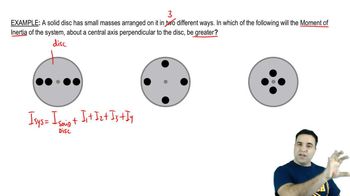
  • In the example with a solid disk and four point masses, what determines the total moment of inertia?

    The total moment of inertia is the sum of the disk's inertia and the inertia of the four masses.
  • If all point masses are the same, what variable affects their contribution to the moment of inertia?

    The distance r from the axis of rotation affects their contribution.
  • Which configuration (A, B, or C) has the greatest moment of inertia and why?

    Configuration B has the greatest moment of inertia because its masses are farthest from the center.
  • Which configuration has the smallest moment of inertia and why?

    Configuration C has the smallest moment of inertia because its masses are closest to the center.
  • How does the arrangement of masses affect the total moment of inertia if the disk and masses are unchanged?

    Only the distances of the masses from the axis (r values) affect the total moment of inertia.
  • What happens to the moment of inertia if you move masses farther from the axis?

    The moment of inertia increases as masses are moved farther from the axis.
  • How does the moment of inertia relate to how fast an object rotates when the same force is applied?

    A greater moment of inertia means the object will rotate more slowly under the same force.
  • What is the formula for the total moment of inertia in a composite system?

    It is the sum of the moments of inertia of all components: I_total = I_disk + I_mass1 + I_mass2 + I_mass3 + I_mass4.
  • Why are the small masses treated as point masses in the example?

    Because they are much smaller than the disk, so their size can be neglected in calculations.
  • If two masses are close to the center and two are far, how does the moment of inertia compare to the other configurations?

    It is intermediate between the configuration with all masses far and all masses close.
  • What physical property does a greater moment of inertia represent in this context?

    It represents greater resistance to changes in rotational motion.
  • If the mass and radius of the disk are the same in all configurations, what causes differences in moment of inertia?

    The differences are caused by how the four point masses are arranged relative to the axis.
  • How can you make a rotating system harder to spin using the same masses?

    By placing the masses farther from the axis, increasing the moment of inertia.