Back

More Conservation of Energy Problems quiz

Control buttons has been changed to "navigation" mode.
1/15
  • What is the mass and radius of the pulley in the given problem?

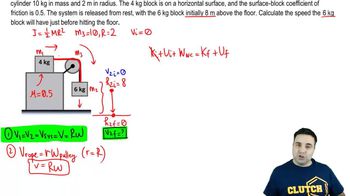
    The pulley has a mass of 10 kg and a radius of 2 m.
  • Which block's potential energy changes significantly during the motion?

    Only the 6 kg block's potential energy changes significantly because it moves vertically.
  • What is the coefficient of friction between the 4 kg block and the surface?

    The coefficient of friction is 0.5.
  • What is the initial height of the 6 kg block above the floor?

    The initial height is 8 meters.
  • What is the relationship between the velocities of the two blocks and the system?

    The velocities of both blocks and the system are equal, so v1 = v2 = vsystem.
  • How is the velocity of the rope related to the angular velocity of the pulley?

    The velocity of the rope equals the radius of the pulley times the angular velocity (v = Rω).
  • What is the formula for the work done by friction in this problem?

    The work done by friction is W_friction = -μmgd, where μ is the coefficient of friction, m is the mass, g is gravity, and d is the distance moved.
  • Which forms of kinetic energy are present at the end of the motion?

    Both blocks have linear kinetic energy, and the pulley has rotational kinetic energy.
  • What is the moment of inertia for a solid cylinder (pulley) used in this problem?

    The moment of inertia is I = (1/2)MR², where M is the mass and R is the radius.
  • Why can the potential energy of the 4 kg block and the pulley be ignored?

    Their heights do not change, so their potential energies remain constant and cancel out in the energy equation.
  • How is the distance the 4 kg block moves related to the height the 6 kg block falls?

    The distance moved by the 4 kg block is equal to the height the 6 kg block falls.
  • What substitution is made for the pulley's angular velocity in the energy equation?

    Angular velocity ω is replaced with v/R, where v is the linear velocity and R is the radius.
  • What is the final algebraic expression for the velocity of the 6 kg block before it hits the floor?

    The final velocity is v = sqrt[4gh(m2 - μm1) / (2m1 + 2m2 + m3)], where m1, m2, m3 are the masses, μ is friction, g is gravity, and h is height.
  • What is the calculated final velocity of the 6 kg block just before it hits the floor?

    The final velocity is approximately 6.47 m/s.
  • Why is it sometimes easier to plug in numbers earlier rather than carrying variables through the entire solution?

    Plugging in numbers earlier simplifies calculations and avoids managing complex algebra with many variables.