Back

Parallel Axis Theorem quiz

Control buttons has been changed to "navigation" mode.
1/15
  • What does the Parallel Axis Theorem allow you to calculate?

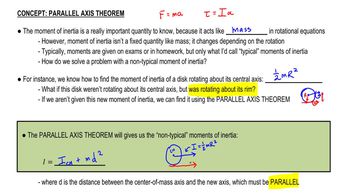
    It allows you to calculate the moment of inertia about any axis parallel to one through the center of mass.
  • What is the formula for the Parallel Axis Theorem?

    I = I_cm + M d^2, where I_cm is the moment of inertia about the center of mass, M is the mass, and d is the distance between axes.
  • Why is the moment of inertia considered a relative quantity?

    Because it depends on the axis of rotation, unlike mass which is fixed.
  • What is the standard moment of inertia for a uniform disk about its center?

    It is (1/2)MR^2, where M is the mass and R is the radius.
  • How do you find the moment of inertia of a disk about its rim?

    Apply the Parallel Axis Theorem: I = (1/2)MR^2 + MR^2 = (3/2)MR^2.
  • What is the moment of inertia of a disk about an axis halfway to the rim?

    It is (3/4)MR^2, found by adding (1/2)MR^2 and (1/4)MR^2.
  • What must be true about the axes when using the Parallel Axis Theorem?

    The axes must be parallel to each other.
  • What is the moment of inertia of a thin rod about an axis at its end?

    It is (1/3)ML^2, where M is the mass and L is the length.
  • How do you find the moment of inertia of a thin rod about its center of mass?

    Use the Parallel Axis Theorem in reverse: I_cm = (1/3)ML^2 - (1/4)ML^2 = (1/12)ML^2.
  • What is the moment of inertia of a thin rod about an axis halfway between the center and the edge?

    It is (7/48)ML^2, calculated using the Parallel Axis Theorem.
  • Why can't you use the Parallel Axis Theorem directly from the edge to halfway to the edge for a rod?

    Because the theorem requires the moment of inertia about the center of mass, not the edge.
  • What is the value of d in the Parallel Axis Theorem for a disk rotating about its rim?

    d equals the radius R of the disk.
  • If the axis is a distance x from the center of mass, what term do you add to I_cm?

    You add Mx^2 to I_cm.
  • What is the first step when using the Parallel Axis Theorem for a non-standard axis?

    Find or know the moment of inertia about the center of mass.
  • How does the moment of inertia halfway to the rim compare to that at the rim for a disk?

    It is exactly half the moment of inertia at the rim.