Back

Push-Away Problems quiz

Control buttons has been changed to "navigation" mode.
1/15
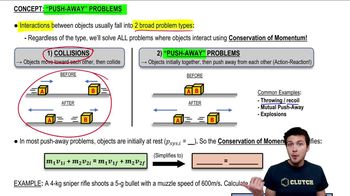
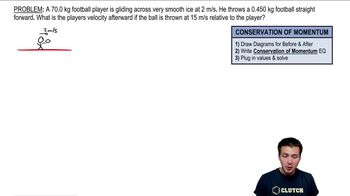
  • What is a 'push away problem' in physics?

    A push away problem involves objects initially together and at rest, which then move apart in opposite directions due to internal forces.
  • How does conservation of momentum simplify in push away problems where objects start at rest?

    The initial momentum is zero, so the final momenta of the objects must sum to zero, simplifying the equation to negative m1v1final equals m2v2final.
  • In the sniper rifle example, why does the gun recoil when the bullet is fired?

    The gun recoils because the bullet gains momentum in one direction, and the gun must gain equal momentum in the opposite direction to conserve momentum.
  • What is the recoil speed of a 4 kg sniper rifle when it fires a 5 g bullet at 600 m/s?

    The recoil speed is -0.75 m/s, indicating the gun moves in the opposite direction to the bullet.
  • Why must the system be isolated for momentum to be conserved?

    Momentum is conserved only if all forces are internal to the system; external forces would violate conservation of momentum.
  • What happens if you include an external force, like a hand pushing the gun, in your system?

    Momentum is not conserved because the external force acts from outside the defined system.
  • What is the general form of the conservation of momentum equation for push away problems?

    It is m1v1initial + m2v2initial = m1v1final + m2v2final, which often simplifies to negative m1v1final = m2v2final when initial velocities are zero.
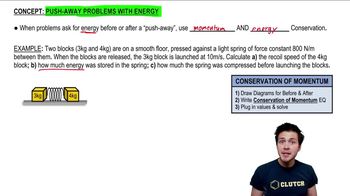
  • In the spring and blocks example, what is the initial velocity of the blocks before release?

    The initial velocity of both blocks is zero because they are at rest before the spring is released.
  • How do you calculate the recoil speed of the second block in the spring example?

    Use momentum conservation: negative m1v1final = m2v2final, and solve for v2final using the given masses and velocities.
  • What is the recoil speed of the 4 kg block if the 3 kg block is launched at -10 m/s?

    The recoil speed of the 4 kg block is 7.5 m/s in the opposite direction.
  • How is energy conservation used in push away problems involving springs?

    The elastic potential energy stored in the spring is converted into the kinetic energy of the blocks after release.
  • What is the formula for the elastic potential energy stored in a spring?

    Elastic potential energy is given by U = 1/2 k x^2, where k is the spring constant and x is the compression distance.
  • How do you calculate the total kinetic energy of two blocks after a spring releases them?

    Add the kinetic energies: 1/2 m1 v1final^2 + 1/2 m2 v2final^2.
  • If the spring constant is 800 N/m and the stored energy is 262.5 J, what is the compression distance?

    The compression distance is x = sqrt(2 * U / k), which calculates to 0.81 meters.
  • Why is it important to define the system correctly in push away problems?

    Defining the system ensures all forces are internal, allowing the use of conservation of momentum and energy principles.