Skip to main content
Physics
My Course
Learn
Exam Prep
AI Tutor
Study Guides
Textbook Solutions
Flashcards
Explore
Try the app
My Course
Learn
Exam Prep
AI Tutor
Study Guides
Textbook Solutions
Flashcards
Explore
Try the app
Back
Reflection of Light quiz
You can tap to flip the card.
What is geometric optics?
You can tap to flip the card.
👆
What is geometric optics?
Geometric optics is the study of light as rays that travel in straight lines, even though light is composed of waves.
Track progress
Control buttons has been changed to "navigation" mode.
1/15
Related flashcards
Related practice
Recommended videos
Reflection of Light definitions
Reflection of Light
15 Terms
Reflection of Light
33. Geometric Optics
4 problems
Topic
Patrick
Index of Refraction
33. Geometric Optics
1 problem
Topic
Jonathan
33. Geometric Optics - Part 1 of 2
5 topics
9 problems
Chapter
Patrick
33. Geometric Optics - Part 2 of 2
4 topics
9 problems
Chapter
Patrick
Guided course
06:25
Law of Reflection
6862
views
136
rank
1
comments
Terms in this set (15)
Hide definitions
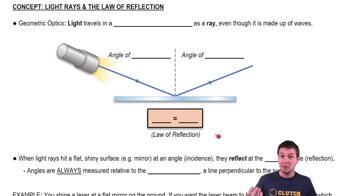
What is geometric optics?
Geometric optics is the study of light as rays that travel in straight lines, even though light is composed of waves.
How is light modeled in geometric optics?
Light is modeled as rays, represented by arrows, traveling in a fixed direction at a constant speed.
What happens when light hits a flat, shiny surface like a mirror?
When light hits a flat, shiny surface, it reflects, meaning the light ray bounces off the surface at a specific angle.
What is the law of reflection?
The law of reflection states that the angle of incidence (incoming angle) is equal to the angle of reflection (outgoing angle).
What are the names of the two angles involved in reflection?
The angle of incidence (theta I) is the incoming angle, and the angle of reflection (theta R) is the outgoing angle.
How are angles measured in geometric optics diagrams?
Angles are measured relative to the normal, which is a line perpendicular to the surface, not relative to the horizontal.
Why is it important to measure angles relative to the normal?
Measuring angles relative to the normal ensures accuracy in calculations; measuring from the horizontal can lead to incorrect answers.
What is the normal in geometric optics?
The normal is a line drawn perpendicular (90 degrees) to the reflective surface.
How do you calculate the angle of incidence in a reflection problem involving a triangle?
You use trigonometric functions, such as tangent, with the known distances to solve for the angle.
If a laser beam hits a mirror and the reflected beam travels 4 meters horizontally and 2 meters vertically, how do you find the angle of incidence?
You use the tangent function: tan(theta) = opposite/adjacent = 4/2, then take the inverse tangent to find the angle.
What is the value of the angle of incidence if tan(theta) = 4/2?
The angle of incidence is 63 degrees, which is also the angle of reflection.
What is specular reflection?
Specular reflection occurs when light reflects off a smooth surface, causing rays to bounce at predictable angles.
What is diffuse reflection?
Diffuse reflection happens when light hits a rough surface, causing the rays to scatter in many directions.
In typical physics problems, which type of reflection is assumed?
Physics problems usually assume specular reflection from smooth surfaces.
Why are surfaces assumed to be perfectly flat in reflection problems?
Assuming perfectly flat surfaces ensures predictable reflection angles and simplifies calculations.
 BackBack

 06:25
06:25