What is the main difference between a fixed wheel and a free wheel in rolling motion?
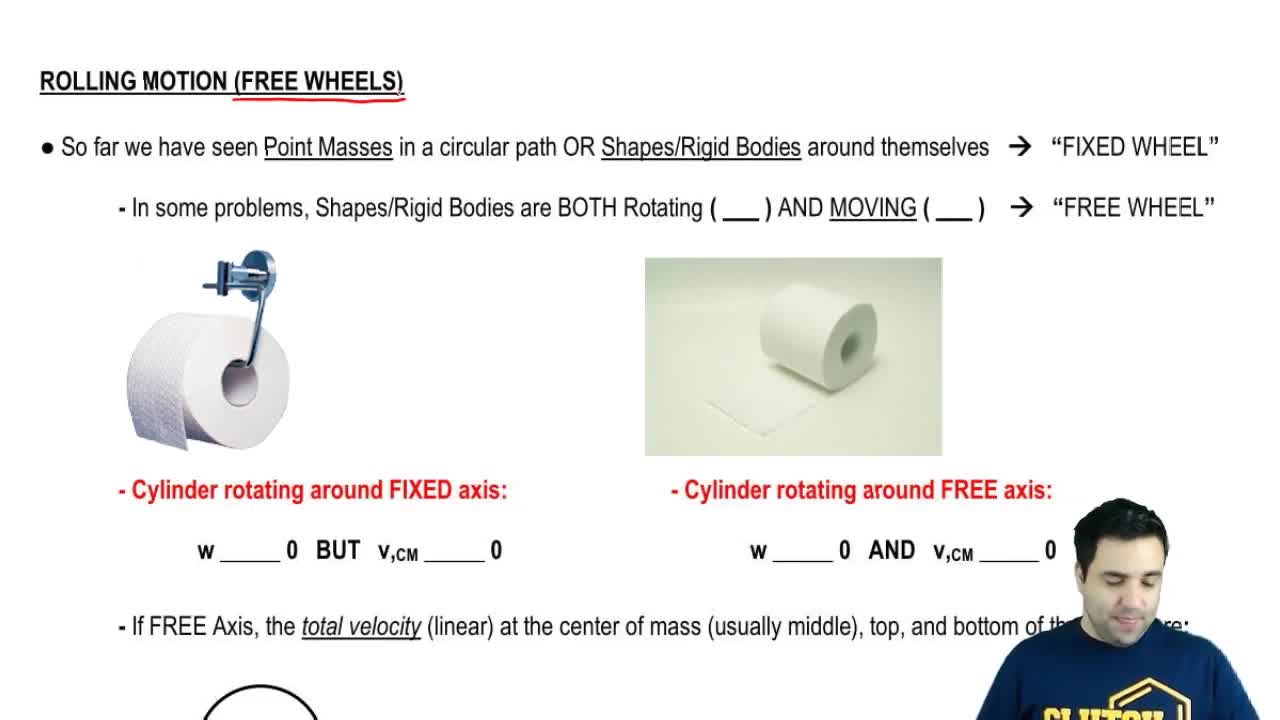
A fixed wheel rotates around a fixed axis with no movement of its center of mass, while a free wheel both rotates and translates, so its center of mass moves.
In the context of rolling motion, what does the velocity of the center of mass (V_CM) represent?
V_CM represents the translational velocity of the wheel's center of mass as it moves along a surface.
What is the key equation relating the velocity of the center of mass and angular velocity for a rolling wheel?
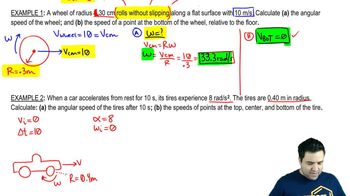
The key equation is V_CM = R * omega, where R is the radius of the wheel and omega is its angular velocity.
When does the equation V_CM = R * omega apply to a rolling wheel?
This equation applies only when the wheel is rolling without slipping.
What is the velocity of the top point of a rolling wheel relative to the ground?
The velocity at the top of the wheel is 2 * R * omega, which is twice the velocity of the center of mass.
What is the velocity of the bottom point of a rolling wheel relative to the floor?
The velocity at the bottom of the wheel is zero relative to the floor.
How do you calculate the angular speed (omega) of a rolling wheel if you know V_CM and R?
Angular speed omega is calculated as omega = V_CM / R.
If a wheel of radius 0.3 m rolls without slipping at 10 m/s, what is its angular speed?
The angular speed is omega = 10 / 0.3 = 33.3 radians per second.
Why is the velocity at the bottom of a rolling wheel zero relative to the floor?
Because the rotational and translational velocities at that point cancel each other out.
What is the condition required for the rolling motion equations to be valid?
The wheel must roll without slipping for the equations to be valid.
In rolling motion, what does 'rolling without slipping' mean?
It means that the point of contact between the wheel and the surface does not slide; it is momentarily at rest relative to the surface.
How does the velocity at the top of a rolling wheel compare to the velocity of its center of mass?
The velocity at the top is twice the velocity of the center of mass.
For a fixed wheel, what is the velocity of the center of mass?
For a fixed wheel, the velocity of the center of mass is zero.
What practical example is used to illustrate the difference between fixed and free wheels?
A roll of toilet paper is used, with a fixed roll representing a fixed axis and a rolling roll representing a free axis.
What is the formula for the velocity at the top, center, and bottom of a rolling wheel?
The velocities are: top = 2R*omega, center = R*omega, and bottom = 0 (relative to the floor).
 Back
Back


 08:47
08:47