What is a compression wave of gas, liquid, or solid that is detected by your ear?
A sound wave is a compression wave of gas, liquid, or solid detected by your ear.
Sound waves are converted into mechanical movements by which part of the ear?
Sound waves are converted into mechanical movements by the eardrum.
If the sound intensity of a jackhammer is about 100 times the sound intensity of a compactor, how do their decibel levels compare?
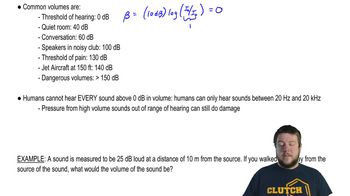
The jackhammer's decibel level is 20 dB higher than the compactor's, since each factor of 10 in intensity corresponds to 10 dB.
For a sound at 100 Hz, what is the decibel level necessary for human perception?
The decibel level necessary for human perception is 0 dB, which is the threshold of hearing, but actual perception may require a higher level depending on frequency sensitivity.
How do you find the intensity I of the sound waves produced by a speaker of power P at a distance r from the speaker?
The intensity I is given by I = P / (4πr²), where P is the power of the speaker and r is the distance from the source.
What does it mean for a sound source to emit sound isotropically?
Emitting sound isotropically means the source emits sound equally in all directions. This results in the sound spreading out over the surface of a sphere as it travels away from the source.
How does the intensity of a sound wave change as you move farther from the source, assuming no absorption?
The intensity decreases with the square of the distance from the source because the same power is spread over a larger area. Specifically, intensity is inversely proportional to the square of the distance.
What is the mathematical relationship between intensity and maximum pressure in a sound wave?
Intensity is given by one half times the square of the maximum pressure divided by the product of the medium's density and the speed of sound. This links the energy carried by the wave to the pressure variations it causes.
Why is a logarithmic scale used for measuring sound intensity level (volume)?
A logarithmic scale is used because human perception of volume only changes noticeably with large, multiplicative changes in intensity. This allows the decibel scale to better match how we experience changes in loudness.
What is the threshold of pain in terms of sound intensity level, and what physical effect can sounds above this level have?
The threshold of pain is about 130 decibels, above which sounds can cause immediate discomfort or damage to hearing. Extremely loud sounds above this level can even be physically felt as pressure, regardless of whether they are within the audible frequency range.
What physical property of a sound wave determines its loudness as perceived by humans?
The loudness of a sound wave, as perceived by humans, is determined by its intensity level, which is related to the intensity of the sound wave. Intensity is the amount of power carried by the wave per unit area, and intensity level (measured in decibels) uses a logarithmic scale to reflect how changes in intensity correspond to changes in perceived loudness.
How is the strength of a sound wave quantitatively measured in physics?
The strength of a sound wave is quantitatively measured by its intensity, which is defined as the power carried by the wave per unit area. Mathematically, intensity (I) is given by I = P/A, where P is the power and A is the area over which the power is distributed. For a spherical wave, intensity decreases with the square of the distance from the source.
 Back
Back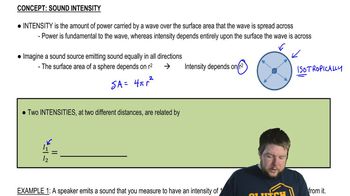
 07:13
07:13