Skip to main content
Physics with Calculus
My Course
Learn
Exam Prep
AI Tutor
Study Guides
Textbook Solutions
Flashcards
Explore
Try the app
My Course
Learn
Exam Prep
AI Tutor
Study Guides
Textbook Solutions
Flashcards
Explore
Try the app
Back
Spinning on String of Variable Length quiz
You can tap to flip the card.
What principle explains why the block spins faster as the string's length decreases?
You can tap to flip the card.
👆
What principle explains why the block spins faster as the string's length decreases?
The conservation of angular momentum explains this, as reducing the radius increases the rotational speed to keep angular momentum constant.
Track progress
Control buttons has been changed to "navigation" mode.
1/15
Related flashcards
Related practice
Recommended videos
Spinning on String of Variable Length definitions
Spinning on String of Variable Length
15 Terms
Spinning on String of Variable Length
16. Angular Momentum
1 problem
Topic
Emilee
16. Angular Momentum - Part 1 of 2
7 topics
16 problems
Chapter
Patrick
16. Angular Momentum - Part 2 of 2
1 topic
3 problems
Chapter
Guided course
10:54
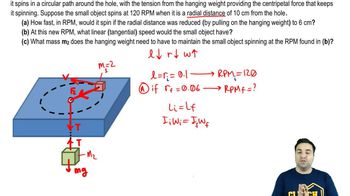
Spinning on a string of variable length
3204
views
16
rank
1
comments
Terms in this set (15)
Hide definitions
What principle explains why the block spins faster as the string's length decreases?
The conservation of angular momentum explains this, as reducing the radius increases the rotational speed to keep angular momentum constant.
What provides the centripetal force for the spinning block in this setup?
The tension in the string, created by the hanging mass, provides the necessary centripetal force.
How is the angular momentum of the block expressed mathematically in this scenario?
It is expressed as I_initial * omega_initial = I_final * omega_final, where I is the moment of inertia and omega is the angular velocity.
For a point mass, how do you express the moment of inertia (I)?
For a point mass, the moment of inertia is I = m * r^2, where m is mass and r is the radius from the axis of rotation.
What happens to the block's RPM if the radius is reduced from 0.10 m to 0.06 m?
The RPM increases, specifically from 120 RPM to 333 RPM, due to conservation of angular momentum.
How do you relate angular velocity (omega) to RPM?
Angular velocity omega is related to RPM by omega = 2π * RPM / 60.
What is the formula to find the final RPM when the radius changes?
RPM_final = (r_initial^2 / r_final^2) * RPM_initial.
How do you calculate the tangential (linear) speed of the block at a given RPM and radius?
Tangential speed v = r * omega, where omega is the angular velocity corresponding to the RPM.
What is the tangential speed of the block when the radius is 0.06 m and RPM is 333?
The tangential speed is 2.1 meters per second.
What equation relates the tension in the string to the centripetal force needed for circular motion?
Tension (T) equals the centripetal force, so T = m * v^2 / r.
How is the tension in the string related to the hanging mass?
The tension equals the weight of the hanging mass, so T = m2 * g.
How do you solve for the required hanging mass (m2) to maintain a certain RPM?
Set m2 * g = m1 * v^2 / r, then solve for m2: m2 = m1 * v^2 / (g * r).
What value of hanging mass (m2) is needed to keep the block spinning at 333 RPM with a radius of 0.06 m?
A hanging mass of 15 kilograms is needed.
If you want the block to spin even faster, what must happen to the hanging mass?
The hanging mass must be increased to provide more tension and thus more centripetal force.
Why is the string assumed to be massless in this problem?
Assuming the string is massless simplifies calculations by ensuring it does not contribute to the system's inertia or affect the tension.
 BackBack

 10:54
10:54