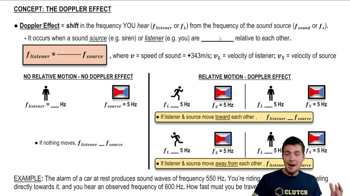
The Doppler effect is the change in frequency of sound due to the relative motion between the sound source and the listener.
What happens to the frequency heard when the listener moves towards the sound source?
The listener hears a higher frequency than the source produces when moving towards the sound source.
What is the equation for the Doppler effect?
The equation is FL = (v + vL) / (v + vS) * FS, where FL is the frequency heard, FS is the source frequency, v is the speed of sound, vL is listener velocity, and vS is source velocity.
What is the frequency heard if both the listener and the source are stationary?
The frequency heard is equal to the frequency produced by the source.
What causes the Doppler effect?
The Doppler effect is caused by relative motion between the sound source and the listener.
What happens to the frequency heard when the listener moves away from the sound source?
The listener hears a lower frequency than the source produces when moving away from the sound source.
What is the value of v in the Doppler effect equation?
v is the speed of sound, typically 343 meters per second in air.
What does vL represent in the Doppler effect equation?
vL represents the velocity of the listener.
What does vS represent in the Doppler effect equation?
vS represents the velocity of the sound source.
How does the direction of positive velocity get established in Doppler effect problems?
The direction of positive is always from the listener to the source.
What happens to sound waves when the source moves towards the listener?
The waves get crammed together in front of the source, resulting in a higher frequency heard by the listener.
What happens to sound waves when the source moves away from the listener?
The waves get stretched out behind the source, resulting in a lower frequency heard by the listener.
In the practice problem, what was the observed frequency by the motorcycle rider?
The observed frequency was 600 Hz.
In the practice problem, what was the frequency produced by the stationary car?
The frequency produced by the car was 550 Hz.
What was the calculated speed of the motorcycle rider towards the sound source in the practice problem?
 Back
Back
 07:40
07:40