Back

Thin Lens And Lens Maker Equations quiz

Control buttons has been changed to "navigation" mode.
1/15
  • What is the thin lens equation used for in optics?

    The thin lens equation is used to find numeric answers for image location and height, replacing ray diagrams for lenses.
  • How is a thin lens defined in terms of its radius of curvature and thickness?

    A thin lens has a radius of curvature much larger than its thickness, often only a few millimeters thick compared to a radius of several centimeters.
  • Name the five basic types of thin lenses.

    The five types are biconvex, convex-concave, plano-convex, biconcave, and plano-concave.
  • How can you distinguish between converging and diverging lenses based on their shape?

    Converging lenses are thickest in the middle, while diverging lenses are thinnest in the middle.
  • What is the sign of the focal length for converging and diverging lenses?

    The focal length is positive for converging lenses and negative for diverging lenses.
  • What is the relationship between the thin lens equation and the mirror equation?

    The thin lens equation is identical to the mirror equation, as both are based on geometry.
  • What does a positive image distance indicate about the image produced by a lens?

    A positive image distance means the image is real and inverted.
  • What does a negative image distance indicate about the image produced by a lens?

    A negative image distance means the image is virtual and upright.
  • Is the magnification equation for thin lenses different from that for mirrors?

    No, the magnification equation for thin lenses is identical to that for mirrors.
  • What three factors determine the focal length of a thin lens according to the lens maker equation?

    The focal length depends on the radii of curvature of the near and far glass and the index of refraction of the glass.
  • Write the lens maker equation for a thin lens.

    The lens maker equation is (n - 1) × (1/r1 - 1/r2), where n is the index of refraction, r1 is the radius of the near glass, and r2 is the radius of the far glass.
  • How do you determine the sign of the radius of curvature in the lens maker equation?

    If the center of curvature is behind the lens, the radius is positive; if it is in front of the lens, the radius is negative.
  • What fundamental result does the lens maker equation show about the focal length of a lens?

    The focal length remains the same regardless of which side of the lens the object is placed.
  • What assumption about ray diagrams is confirmed by the lens maker equation?

    The lens maker equation confirms that the focus is at the same distance on either side of the lens.
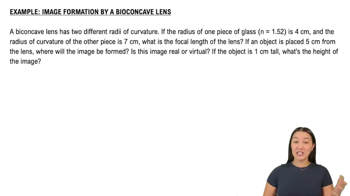
  • If a biconcave lens has a focal length of -2 cm and an object is placed 7 cm in front, what type of image is formed?

    A virtual, upright image is formed because the image distance is negative.