In which quadrant are both the x and y components of a vector positive?
Both components are positive in quadrant 1 (the top right corner of the XY plane).
How do you determine the sign of a vector component based on its direction?
Components pointing up or to the right are positive, while those pointing down or to the left are negative.
What is always true about the magnitude of a vector, regardless of its quadrant?
The magnitude of a vector is always positive.
What is a reference angle when working with vectors, and why is it important?
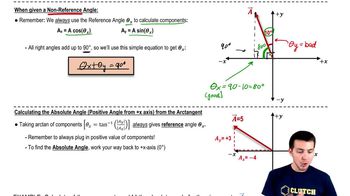
A reference angle is the angle measured from the nearest x-axis, and it is used to calculate vector components with trigonometric functions.
How do you find the reference angle if you are given an angle relative to the y-axis?
Subtract the given angle from 90 degrees to get the reference angle relative to the x-axis.
What is the absolute angle of a vector, and how is it measured?
The absolute angle is measured from the positive x-axis to the vector, often requiring you to add or subtract known angles to reach the vector's direction.
If a vector's reference angle is 37 degrees in the second quadrant, what is its absolute angle?
The absolute angle is 180 - 37 = 143 degrees.
How do you calculate the x and y components of a vector given its magnitude and reference angle?
The x component is magnitude times cosine of the reference angle, and the y component is magnitude times sine of the reference angle.
When given a vector at 22.6 degrees relative to the y-axis with a magnitude of 13, what reference angle should you use for components?
Use 90 - 22.6 = 67.4 degrees as the reference angle.
What sign do you assign to vector components in the third quadrant?
Both x and y components are negative in the third quadrant.
How are counterclockwise and clockwise angles treated in terms of sign?
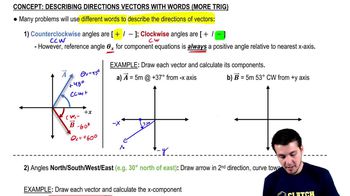
Counterclockwise angles are positive, and clockwise angles are negative.
When using the component equations, what value should you use for the angle, regardless of its sign?
Always use the positive value of the reference angle relative to the nearest x-axis.
How do you interpret a direction like '30 degrees North of East' when drawing a vector?
Start by drawing the arrow east, then curve 30 degrees towards the north.
If a vector is described as '53 degrees West of South,' how do you determine the reference angle for the x component?
Subtract 53 from 90 to get 37 degrees, which is the reference angle relative to the x-axis.
Why is it important to adjust the sign of vector components after calculating their magnitudes?
Because the sign depends on the direction of the component in the XY plane, not just the magnitude calculation.
 Back
Back
 06:03
06:03