Skip to main content
Physics
My Course
Learn
Exam Prep
AI Tutor
Study Guides
Textbook Solutions
Flashcards
Explore
Try the app
My Course
Learn
Exam Prep
AI Tutor
Study Guides
Textbook Solutions
Flashcards
Explore
Try the app
Back
Intro to Waves definitions
You can tap to flip the card.
Oscillation
You can tap to flip the card.
👆
Oscillation
A repetitive movement that is a key characteristic of waves, involving up and down or back and forth motion.
Track progress
Control buttons has been changed to "navigation" mode.
1/15
Related flashcards
Recommended videos
Intro to Waves quiz
Intro to Waves
10 Terms
Intro to Waves quiz #1
Intro to Waves
40 Terms
Intro to Waves quiz #2
Intro to Waves
40 Terms
Guided course
02:27
Properties of Waves from Graphs
1293
views
21
rank
1
comments
Guided course
08:56
Types of Waves
1258
views
14
rank
4
comments
Guided course
10:23
What Is A Wave?
1900
views
35
rank
Terms in this set (15)
Hide definitions
Oscillation
A repetitive movement that is a key characteristic of waves, involving up and down or back and forth motion.
Energy
A fundamental property carried by all waves, varying in type and calculable based on the wave type.
Periodic Waves
Waves with repeating cycles, where each cycle begins and ends in the same state.
Cycle
A portion of a wave's motion that starts and ends in the same state, often measured from peak to peak.
Period
The time it takes for a wave to complete one cycle, denoted by the symbol T.
Frequency
The number of cycles a wave completes per unit time, often measured in hertz (Hz).
Wavelength
The distance a wave travels in one cycle, represented by the Greek letter Lambda (λ).
Speed
The rate at which a wave travels through a medium, calculated as wavelength times frequency.
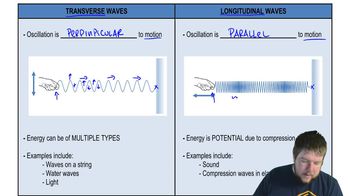
Transverse Waves
Waves where oscillation is perpendicular to the direction of propagation, like waves on a string.
Longitudinal Waves
Waves where oscillation is parallel to the direction of propagation, such as sound waves.
Propagation
The direction in which a wave travels through a medium.
Amplitude
The maximum displacement of a wave from its rest position.
Compression
An area in a longitudinal wave where particles are close together.
Rarefaction
An area in a longitudinal wave where particles are spread apart.
Elastic Medium
A material that can return to its original shape after being compressed or stretched, crucial for wave propagation.
 BackBack
 02:27
02:27