Skip to main content
Physics
My Course
Learn
Exam Prep
AI Tutor
Study Guides
Textbook Solutions
Flashcards
Explore
Try the app
My Course
Learn
Exam Prep
AI Tutor
Study Guides
Textbook Solutions
Flashcards
Explore
Try the app
Back
Intro to Waves quiz #2
You can tap to flip the card.
What creates a sound (mechanical) wave?
You can tap to flip the card.
👆
What creates a sound (mechanical) wave?
A sound wave is created by a vibrating object causing compressions and rarefactions in a medium.
Track progress
Control buttons has been changed to "navigation" mode.
1/40
Related flashcards
Recommended videos
Intro to Waves definitions
Intro to Waves
15 Terms
Intro to Waves quiz
Intro to Waves
10 Terms
Intro to Waves quiz #1
Intro to Waves
40 Terms
Guided course
02:27
Properties of Waves from Graphs
1293
views
21
rank
1
comments
Guided course
08:56
Types of Waves
1258
views
14
rank
4
comments
Guided course
10:23
What Is A Wave?
1900
views
35
rank
Terms in this set (40)
Hide definitions
What creates a sound (mechanical) wave?
A sound wave is created by a vibrating object causing compressions and rarefactions in a medium.
How are sound waves and light waves alike?
Both sound and light waves carry energy and can be described by amplitude, wavelength, frequency, and speed.
Through which can a mechanical wave travel?
A mechanical wave can travel through solids, liquids, or gases.
Which of these is a longitudinal wave?
A sound wave is an example of a longitudinal wave.
What type of wave is produced when you move one end of a horizontal spring up and down?
Moving one end of a horizontal spring up and down produces a transverse wave.
What kind of wave is able to travel through both matter and empty space?
Electromagnetic waves can travel through both matter and empty space.
Which type of wave can carry both electromagnetic and mechanical energy?
Waves as a general concept can carry either electromagnetic or mechanical energy, depending on the type.
If the height of a water wave is doubled, what happens to its amplitude?
If the height of a water wave is doubled, its amplitude is also doubled.
Sound is what kind of wave?
Sound is a longitudinal mechanical wave.
What is traveling with a wave in the ocean?
Energy is traveling with a wave in the ocean.
Sound is an example of what type of wave?
Sound is an example of a mechanical longitudinal wave.
Which type of wave does not require a medium in which to travel?
Electromagnetic waves do not require a medium to travel.
Which waves are capable of propagating without a medium?
Electromagnetic waves are capable of propagating without a medium.
What kind of waves are water waves?
Water waves are surface waves with both transverse and longitudinal components.
Which type of wave has a wave perpendicular to the disturbance?
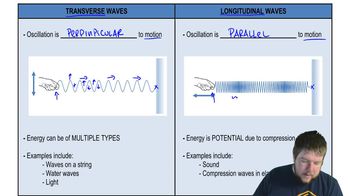
A transverse wave has oscillations perpendicular to the direction of propagation.
Which type of earthquake wave moves the fastest?
Primary waves (P-waves), which are longitudinal, move the fastest during an earthquake.
How are transverse and longitudinal waves similar?
Both transverse and longitudinal waves carry energy and can be described by amplitude, wavelength, frequency, and speed.
How do mechanical and electromagnetic waves differ?
Mechanical waves require a medium to travel, while electromagnetic waves do not.
What travels on a wave?
Energy travels on a wave.
What is not a property of a wave?
Mass is not a property of a wave; key properties include amplitude, wavelength, frequency, period, and speed.
Is sound a longitudinal or transverse wave?
Sound is a longitudinal wave.
What question can determine whether a wave is a mechanical wave or an electromagnetic wave?
Does the wave require a medium to travel? If yes, it is a mechanical wave; if no, it is an electromagnetic wave.
How are longitudinal and transverse waves alike?
Both types of waves carry energy and can be described by amplitude, wavelength, frequency, and speed.
What do P-waves do when they hit the Earth's liquid interior layer?
P-waves (longitudinal waves) can travel through both solids and liquids, so they continue to propagate through the Earth's liquid interior.
Which wave requires a physical medium through which to travel?
A mechanical wave requires a physical medium to travel.
Which type of wave has the longest wavelength?
Among seismic waves, surface waves can have the longest wavelengths; in general, wavelength depends on the wave type and its frequency.
A certain wave has compressions and rarefactions. How should this wave be classified?
A wave with compressions and rarefactions is a longitudinal wave.
What materials will you need to create a wave?
To create a mechanical wave, you need a medium such as a string, spring, water, or air.
What can change the frequency of a wave?
The frequency of a wave can be changed by altering the source of the oscillation.
What is the period of a wave if 20 crests pass an observer in 4 seconds?
The period T = total time / number of cycles = 4 seconds / 20 = 0.2 seconds.
Why will mechanical waves not travel in a vacuum?
Mechanical waves require a medium to transmit energy, so they cannot travel in a vacuum.
Which type of wave does not require a medium in which to travel: sound, water, light, or mechanical?
Light (an electromagnetic wave) does not require a medium to travel.
What is an example of a mechanical wave?
A wave on a string is an example of a mechanical wave.
Which waves can travel only through solids?
Some types of mechanical waves, such as S-waves (secondary seismic waves), can travel only through solids.
What causes a disturbance that results in a wave?
A disturbance that results in a wave is caused by a source of oscillation or vibration.
What type of wave is a microwave: heat, longitudinal, sound, or transverse?
A microwave is a type of electromagnetic wave, which is transverse.
Which phrases describe S-waves?
S-waves are transverse seismic waves that move the ground perpendicular to the direction of propagation and can only travel through solids.
When earthquakes produce vibrations called waves, what type of waves are produced?
Earthquakes produce both longitudinal (P-waves) and transverse (S-waves) as well as surface waves.
What is the main difference between a longitudinal wave and a transverse wave?
In a longitudinal wave, oscillations are parallel to propagation; in a transverse wave, oscillations are perpendicular to propagation.
Which type of wave has a wave perpendicular to the disturbance?
A transverse wave has oscillations perpendicular to the direction of propagation.
 BackBack
 02:27
02:27