What is the main difference between electromagnetic waves and mechanical waves?
Electromagnetic waves do not require a medium to travel through, while mechanical waves require a medium (such as a solid, liquid, or gas) to propagate.
What type of waves are produced by a moving or vibrating object?
Mechanical waves are produced by a moving or vibrating object.
What is an example of a mechanical wave?
Examples of mechanical waves include sound waves, water waves, and waves on a string.
What can be said about the amplitude of any transverse wave?
The amplitude of a transverse wave is the maximum displacement from its equilibrium position.
Which energy source harnesses the power of waves?
Wave energy harnesses the power of ocean waves, which are mechanical waves.
What is transmitted by all waves?
All waves transmit energy.
What kind of waves require a medium to travel through?
Mechanical waves require a medium to travel through.
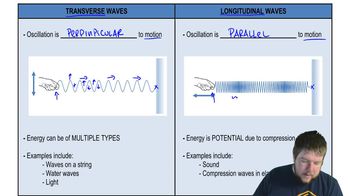
What is the difference between a transverse wave and a longitudinal wave?
In a transverse wave, the oscillation is perpendicular to the direction of propagation, while in a longitudinal wave, the oscillation is parallel to the direction of propagation.
What is the difference between a wave and a medium?
A wave is a moving disturbance that carries energy, while a medium is the material through which a mechanical wave travels.
How can you describe the differences between waves?
Waves can differ by their type (transverse or longitudinal), the direction of oscillation relative to propagation, whether they require a medium, and their characteristics such as amplitude, wavelength, frequency, and speed.
What characteristic of a mechanical wave differentiates it from an electromagnetic wave?
A mechanical wave requires a medium to travel through, while an electromagnetic wave does not.
What is a defining property of a longitudinal wave?
In a longitudinal wave, the oscillation occurs parallel to the direction of wave propagation.
Which type of waves require matter to travel through?
Mechanical waves require matter (a medium) to travel through.
Which type of wave vibrates both side to side and up and down?
Surface waves, such as water waves, can have both transverse and longitudinal components, causing particles to move in a circular or elliptical motion.
What is the amplitude of a wave?
The amplitude of a wave is the maximum displacement from its equilibrium position.
How do transverse and longitudinal waves differ?
Transverse waves have oscillations perpendicular to the direction of propagation, while longitudinal waves have oscillations parallel to the direction of propagation.
What is a difference between mechanical and electromagnetic waves?
Mechanical waves require a medium to travel, while electromagnetic waves can travel through a vacuum.
What type of wave does not need matter to carry energy?
Electromagnetic waves do not need matter to carry energy.
What are the two types of surface waves?
Surface waves can have both transverse and longitudinal components.
What do sound waves and light waves have in common?
Both sound waves and light waves carry energy and can be described by properties such as amplitude, wavelength, frequency, and speed.
Which type of wave is the first to arrive during an earthquake?
Primary waves (P-waves), which are longitudinal waves, are the first to arrive during an earthquake.
How are electromagnetic waves and mechanical waves different?
Electromagnetic waves do not require a medium and can travel through a vacuum, while mechanical waves require a medium to propagate.
Which type of wave does not require a medium to travel through?
Electromagnetic waves do not require a medium to travel through.
What are some examples of transverse waves?
Examples of transverse waves include waves on a string and electromagnetic waves such as light.
Which wave has a disturbance that is perpendicular to the wave motion?
A transverse wave has a disturbance that is perpendicular to the direction of wave motion.
Which kind of wave moves back and forth along the direction of the wave?
A longitudinal wave moves back and forth along the direction of the wave.
What does frequency measure in a wave?
Frequency measures the number of cycles (oscillations) per unit time.
What kind of disturbance is created by moving a spring toy up and down?
Moving a spring toy up and down creates a transverse wave.
What is the main difference between mechanical waves and electromagnetic waves?
Mechanical waves require a medium to travel, while electromagnetic waves do not.
Which type of seismic wave causes the most destruction to property?
Surface waves, which have both transverse and longitudinal components, typically cause the most destruction during earthquakes.
Which wave type does not need a medium to travel?
Electromagnetic waves do not need a medium to travel.
What is true for waves in any medium?
Waves in any medium carry energy and can be described by properties such as amplitude, wavelength, frequency, and speed.
What is correct regarding a wave in the open ocean?
A wave in the open ocean is a mechanical wave that carries energy through water.
Which type of wave does not require a medium to travel?
Electromagnetic waves do not require a medium to travel.
What is a characteristic of S-waves?
S-waves (secondary waves) are transverse waves that move the ground perpendicular to the direction of propagation.
Which type of wave is a combination of transverse and longitudinal waves?
Surface waves are a combination of transverse and longitudinal waves.
In what type of wave does sound travel?
Sound travels as a longitudinal wave.
A sound wave is what type of wave?
A sound wave is a longitudinal mechanical wave.
When describing waves, what are some key properties?
Key properties of waves include amplitude, wavelength, frequency, period, and speed.
Which types of waves can travel through a vacuum?
Electromagnetic waves can travel through a vacuum.
 Back
Back
 02:27
02:27