How would you test if mechanical waves work in a vacuum?
You could attempt to generate a mechanical wave in a vacuum and observe whether it propagates; if it does not, this confirms that a medium is required.
What do ocean waves and sound waves have in common?
Both ocean waves and sound waves are mechanical waves that require a medium and carry energy.
How are S-waves and vertical surface waves different?
S-waves are transverse waves that move through solids, while surface waves have both transverse and longitudinal components and travel along surfaces.
What do all waves have in common?
All waves carry energy and can be described by amplitude, wavelength, frequency, period, and speed.
Do waves transfer matter?
Waves generally do not transfer matter; they transfer energy through a medium or space.
What is a good analogy for a wave?
A wave can be thought of as a moving disturbance or oscillation that carries energy through a medium or space.
What best describes a wave?
A wave is a moving disturbance or oscillation that carries energy from one place to another.
What is true about waves?
Waves are moving disturbances that carry energy and can be described by amplitude, wavelength, frequency, period, and speed.
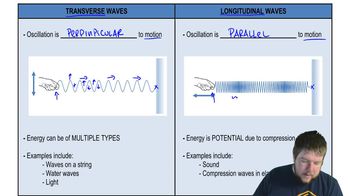
What type of waves are depicted when a string is whipped up and down?
Transverse waves are depicted when a string is whipped up and down.
In a wave, what is transported?
In a wave, energy is transported.
Is there an exception to the rule that waves don't move matter?
Generally, waves do not move matter, but in some cases, such as surface waves, there can be a small net movement of matter.
What do earthquake waves have in common with other waves?
Earthquake waves, like other waves, are moving disturbances that carry energy.
What causes waves in the ocean to occur?
Waves in the ocean are caused by disturbances such as wind or seismic activity.
What causes waves?
Waves are caused by a disturbance or oscillation in a medium or field.
A scientist is studying a shock wave from an earthquake. What kind of wave is being studied?
A shock wave from an earthquake is a type of mechanical wave, specifically a longitudinal wave.
What are the two types of waves?
The two main types of waves are transverse waves and longitudinal waves.
Which statement describes a surface wave?
A surface wave is a combination of transverse and longitudinal motions, typically traveling along the interface between two media.
What are two examples of waves we can see?
Two examples of visible waves are water waves and light waves.
What kind of wave is being generated when a string is moved up and down?
A transverse wave is generated when a string is moved up and down.
What behavior does wave transmission describe?
Wave transmission describes the movement of energy through a medium or space by a wave.
What are the two main forms of energy that travel in waves?
The two main forms of energy that travel in waves are mechanical energy and electromagnetic energy.
Which statement describes a difference between electromagnetic and mechanical waves?
Electromagnetic waves can travel through a vacuum, while mechanical waves require a medium.
What type of wave moves audio and visual signals to your television?
Electromagnetic waves move audio and visual signals to your television.
How does water move as waves pass?
As waves pass, water particles move in a circular or elliptical motion, especially in surface waves.
What are the two types of energy in a wave?
Waves can carry kinetic energy and potential energy.
What is true about how waves form and break upon the shore?
Waves form due to disturbances and can break upon the shore when their amplitude increases and the wave becomes unstable.
What question would be best to ask to determine if a wave is an electromagnetic wave or a mechanical wave?
Does the wave require a medium to travel? If not, it is an electromagnetic wave.
Which statement correctly distinguishes between all mechanical and all electromagnetic waves?
All mechanical waves require a medium to travel, while all electromagnetic waves can travel through a vacuum.
What kind of waves are produced by all musical instruments?
Musical instruments produce mechanical waves, typically sound waves.
What travels in a wave from one location to another?
Energy travels in a wave from one location to another.
A wave is a pattern of motion that transports what?
A wave is a pattern of motion that transports energy.
What are some examples of waves in everyday life?
Examples of waves in everyday life include sound waves, water waves, and light waves.
What is a sound wave?
A sound wave is a longitudinal mechanical wave that propagates through a medium by compressions and rarefactions.
What happens when two waves in the same medium meet?
When two waves in the same medium meet, their displacements add together (superposition).
How does a wave created by a certain source travel?
A wave created by a source travels through a medium (if mechanical) or through space (if electromagnetic), carrying energy away from the source.
An ocean wave would be an example of what type of wave?
An ocean wave is an example of a surface wave with both transverse and longitudinal components.
What does an oscillator create on a stretched string?
An oscillator creates periodic transverse waves on a stretched string.
What is the material through which a wave travels called?
The material through which a wave travels is called a medium.
What is the relationship between frequency and period for a wave?
Frequency and period are inversely related: frequency equals one divided by the period (f = 1/T).
 Back
Back
 02:27
02:27