Skip to main content
Physics
My Course
Learn
Exam Prep
AI Tutor
Study Guides
Textbook Solutions
Flashcards
Explore
Try the app
My Course
Learn
Exam Prep
AI Tutor
Study Guides
Textbook Solutions
Flashcards
Explore
Try the app
Back
Intro to Waves quiz #4
You can tap to flip the card.
What is the distance between one wave and the next called?
You can tap to flip the card.
👆
What is the distance between one wave and the next called?
The distance between one wave and the next is called the wavelength.
Track progress
Control buttons has been changed to "navigation" mode.
1/40
Related flashcards
Recommended videos
Intro to Waves definitions
Intro to Waves
15 Terms
Intro to Waves quiz
Intro to Waves
10 Terms
Intro to Waves quiz #1
Intro to Waves
40 Terms
Guided course
02:27
Properties of Waves from Graphs
1293
views
21
rank
1
comments
Guided course
08:56
Types of Waves
1258
views
14
rank
4
comments
Guided course
10:23
What Is A Wave?
1900
views
35
rank
Terms in this set (40)
Hide definitions
What is the distance between one wave and the next called?
The distance between one wave and the next is called the wavelength.
What is the distance between two crests of a wave?
The distance between two crests of a wave is the wavelength.
What is a medium in the context of waves?
A medium is the material or substance through which a wave travels.
Which type of wave has the longest wavelength?
Among waves, those with the lowest frequency have the longest wavelength, according to the relationship λ = v/f.
What is the frequency of a wave?
The frequency of a wave is the number of cycles that occur per unit time.
What is the relationship between wavelength and frequency?
Wavelength and frequency are inversely related: as frequency increases, wavelength decreases, given a constant wave speed (v = λf).
What type of wave are water waves?
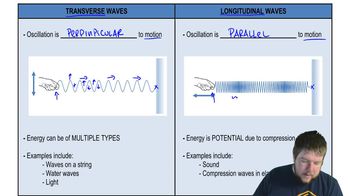
Water waves are primarily transverse waves.
What is the best description of a wave?
A wave is a moving disturbance or oscillation that carries energy through a medium or space.
If the frequency of a wave doubles, what happens to its wavelength (assuming constant speed)?
If frequency doubles and speed remains constant, the wavelength is halved.
What is the crest of a wave?
The crest of a wave is the highest point of the wave.
How do you find the period of a wave?
The period of a wave is found by taking the reciprocal of the frequency: T = 1/f.
How do you measure a wavelength?
Wavelength is measured as the distance between two consecutive points in phase, such as crest to crest or trough to trough.
What is the highest point of a wave called?
The highest point of a wave is called the crest.
What is the source of all wave motion?
The source of all wave motion is an oscillation or vibration.
A wave is a pattern of motion that transports what?
A wave is a pattern of motion that transports energy.
How does amplitude affect wavelength?
Amplitude does not affect wavelength; amplitude is the maximum displacement, while wavelength depends on frequency and speed.
What is the highest point of a transverse wave called?
The highest point of a transverse wave is called the crest.
What does a wave carry?
A wave carries energy.
Can a mechanical wave travel through a vacuum?
No, a mechanical wave cannot travel through a vacuum; it requires a medium.
When amplitude increases, what happens to wavelength?
When amplitude increases, wavelength does not change; amplitude and wavelength are independent properties.
What kind of wave is an ocean wave?
An ocean wave is primarily a transverse wave.
What does a wave transfer?
A wave transfers energy.
What is the distance between adjacent compressions in a longitudinal wave?
The distance between adjacent compressions in a longitudinal wave is the wavelength.
What happens to the wavelength when the frequency increases (assuming constant speed)?
When frequency increases and speed is constant, the wavelength decreases.
What is frequency a measure of?
Frequency is a measure of how many cycles occur per unit time.
What is the measurement of a wave's height?
The measurement of a wave's height is called amplitude.
What does frequency describe in a wave?
Frequency describes how often cycles of the wave occur per unit time.
As frequency increases, what happens to the wavelength (assuming constant speed)?
As frequency increases, wavelength decreases if speed is constant.
What is frequency measured in?
Frequency is measured in hertz (Hz), which is cycles per second.
What defines the amplitude of a wave?
Amplitude is defined as the maximum displacement from the equilibrium position.
Which statement best describes wavelength?
Wavelength is the distance between two consecutive points in phase on a wave, such as crest to crest.
What is matter through which a wave travels called?
Matter through which a wave travels is called a medium.
How are frequency and wave period related?
Frequency and period are inversely related: f = 1/T and T = 1/f.
How does changing the frequency affect the wavelength (assuming constant speed)?
Increasing frequency decreases wavelength, and decreasing frequency increases wavelength, if speed is constant.
How often a wave occurs is the wave’s what?
How often a wave occurs is the wave’s frequency.
How does changing amplitude affect wavelength?
Changing amplitude does not affect wavelength; they are independent properties.
How does wavelength change as frequency increases (at constant speed)?
As frequency increases, wavelength decreases if speed is constant.
How far does a wave travel in one period?
A wave travels one wavelength in one period.
What is a wave?
A wave is a moving disturbance or oscillation that carries energy through a medium or space.
What is a mechanical wave?
A mechanical wave is a wave that requires a medium to travel through.
 BackBack
 02:27
02:27