Skip to main content
Physics
My Course
Learn
Exam Prep
AI Tutor
Study Guides
Textbook Solutions
Flashcards
Explore
Try the app
My Course
Learn
Exam Prep
AI Tutor
Study Guides
Textbook Solutions
Flashcards
Explore
Try the app
Back
Intro to Waves quiz #5
You can tap to flip the card.
What is the highest point of a wave?
You can tap to flip the card.
👆
What is the highest point of a wave?
The highest point of a wave is called the crest.
Track progress
Control buttons has been changed to "navigation" mode.
1/18
Related flashcards
Recommended videos
Intro to Waves definitions
Intro to Waves
15 Terms
Intro to Waves quiz
Intro to Waves
10 Terms
Intro to Waves quiz #1
Intro to Waves
40 Terms
Guided course
02:27
Properties of Waves from Graphs
1293
views
21
rank
1
comments
Guided course
08:56
Types of Waves
1258
views
14
rank
4
comments
Guided course
10:23
What Is A Wave?
1900
views
35
rank
Terms in this set (18)
Hide definitions
What is the highest point of a wave?
The highest point of a wave is called the crest.
What type of wave is an ocean wave?
An ocean wave is primarily a transverse wave.
Through which can a mechanical wave travel?
A mechanical wave can travel through solids, liquids, or gases, but not through a vacuum.
What is the amplitude of a wave?
Amplitude is the maximum displacement from the equilibrium position.
What is the period of a wave?
The period is the time it takes for one complete cycle of the wave.
What is the formula relating wave speed, wavelength, and frequency?
Wave speed equals wavelength times frequency: v = λf.
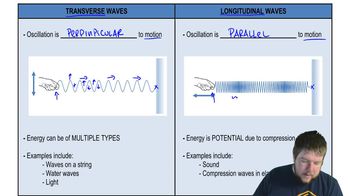
What is a transverse wave?
A transverse wave is a wave in which the oscillation is perpendicular to the direction of propagation.
What is a longitudinal wave?
A longitudinal wave is a wave in which the oscillation is parallel to the direction of propagation.
What is the trough of a wave?
The trough is the lowest point of a wave.
What is the unit of frequency?
The unit of frequency is hertz (Hz).
What is the unit of wavelength in the SI system?
The unit of wavelength in the SI system is the meter (m).
What is the unit of period?
The unit of period is the second (s).
What is the main difference between transverse and longitudinal waves?
In transverse waves, oscillation is perpendicular to propagation; in longitudinal waves, oscillation is parallel to propagation.
Can longitudinal waves propagate in fluids?
Yes, longitudinal waves can propagate in fluids.
Can transverse waves propagate in fluids?
Transverse waves do not propagate well in fluids.
What is the rarefaction in a longitudinal wave?
Rarefaction is the region where particles are spread apart in a longitudinal wave.
What is compression in a longitudinal wave?
Compression is the region where particles are close together in a longitudinal wave.
What is the equilibrium position in a wave?
The equilibrium position is the central position where the medium would be if there were no wave.
 BackBack
 02:27
02:27