 Back
BackFluid Dynamics: Continuity and Bernoulli’s Equation-lecture 22
Study Guide - Smart Notes
 Tailored notes based on your materials, expanded with key definitions, examples, and context.
Fluid Dynamics
Introduction to Fluid Motion
Fluid dynamics is the study of fluids (liquids and gases) in motion. The behavior of fluids can range from smooth, steady flows to chaotic, turbulent streams. Understanding these behaviors is essential for applications in engineering, meteorology, and biology.
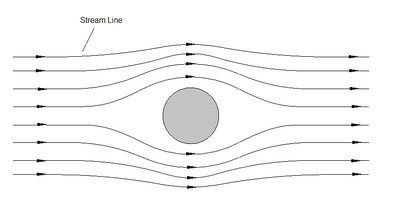
Streamlines: Imaginary lines that represent the trajectories followed by fluid particles. They help visualize the flow pattern around objects.
Types of Fluid Flow:
Steady Flow: The velocity of the fluid at any given point does not change with time.
Unsteady Flow: The velocity at a point changes over time.
Turbulent Flow: A highly irregular and chaotic form of unsteady flow, often seen in rapids or storms.

Compressibility
Compressibility describes how much the density of a fluid changes in response to pressure variations.
Compressible Fluids: Density changes significantly with pressure (e.g., gases).
Incompressible Fluids: Density remains nearly constant during flow (e.g., most liquids).
Viscosity
Viscosity is a measure of a fluid's resistance to deformation or flow, often described as its "stickiness." It determines how much energy is dissipated as the fluid moves.
Viscous Flow: Significant internal friction; energy is lost as heat (e.g., honey).
Nonviscous Flow: Negligible internal friction; no energy dissipation (idealized case).
Ideal Fluids
An ideal fluid is both incompressible and nonviscous. While no real fluid is perfectly ideal, water is often approximated as such in many engineering problems. Graphene, a single layer of carbon atoms, exhibits nearly ideal fluid behavior under certain conditions.

Equation of Continuity
Mass Flow Rate
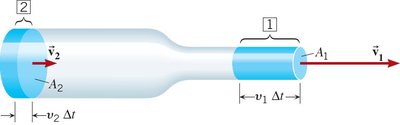
The mass flow rate quantifies the amount of mass passing through a cross-section of a pipe per unit time. For a fluid flowing through a pipe, the mass passing through any two points must be equal if the flow is steady.
The mass of fluid passing through a section in time is:
Dividing both sides by gives the mass flow rate:
For two points (1 and 2) in a pipe:
Equation of Continuity for Incompressible Fluids
For incompressible fluids (constant density), the equation simplifies to:
This is also known as the volume flow rate .
This principle explains why water speeds up when flowing from a wide pipe into a narrow one.
Bernoulli’s Equation
Work and Energy in Fluid Flow
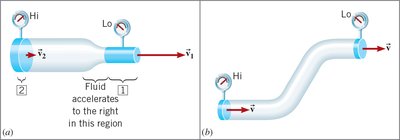
Bernoulli’s equation is derived from the work-energy theorem applied to fluids. It relates the pressure, velocity, and elevation at two points along a streamline in steady, incompressible, nonviscous flow.
The work done to move fluid from point 1 to point 2:
Work in terms of pressure difference:
Equating the two and dividing by volume (where ):
Applications of Bernoulli’s Equation
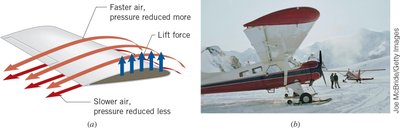
Bernoulli’s equation explains many phenomena, such as how airplanes generate lift. Faster airflow over the curved top of a wing creates lower pressure compared to the bottom, resulting in an upward lift force.
Lift Force: Generated due to pressure differences above and below the wing.
Practical Example: Airplane wings are designed to maximize this effect for efficient flight.
Summary Table: Types of Fluid Flow
Type of Flow | Description | Example |
|---|---|---|
Steady | Velocity constant at each point | Calm river |
Unsteady | Velocity changes with time | Waves in the ocean |
Turbulent | Chaotic, irregular motion | Whitewater rapids |
