 Back
BackGravity, Fluids, and Heat: Key Concepts and Problem Examples
Study Guide - Smart Notes
 Tailored notes based on your materials, expanded with key definitions, examples, and context.
Gravity and Orbital Motion
Universal Law of Gravity
The Universal Law of Gravity describes the attractive force between any two masses. This law is fundamental to understanding planetary motion, tides, and satellite orbits.
Newton's Law of Universal Gravitation: Every mass attracts every other mass with a force proportional to the product of their masses and inversely proportional to the square of the distance between their centers.
Equation:
G is the universal gravitational constant ().
g is the acceleration due to gravity at Earth's surface ().
Gravity decreases with the square of the distance from the center of mass.
Ocean Tides
Ocean tides are caused by the gravitational pull of the Moon (and to a lesser extent, the Sun) on Earth's oceans, resulting in periodic rises and falls in sea level.
Projectile Motion
Projectile motion refers to the curved path an object follows when thrown or propelled near the surface of the Earth, under the influence of gravity alone.
It is a combination of horizontal motion at constant velocity and vertical motion under constant acceleration due to gravity.
Satellite Circular Orbits
A satellite in a circular orbit moves at a constant speed along a path equidistant from the center of the Earth. The period depends on the altitude of the orbit.
Elliptical Orbits
Elliptical orbits are oval-shaped paths followed by planets and satellites, with varying speed depending on their distance from the focus (usually the center of mass).
Escape Speed
Escape speed is the minimum speed an object must reach to break free from a planet's gravitational field without further propulsion.
Equation:
Where M is the mass of the planet and R is its radius.
Fluids: Properties and Motion
Liquids: Pressure and Pascal's Principle
Pressure in a fluid is the force exerted per unit area. Pascal's Principle states that a change in pressure applied to an enclosed fluid is transmitted undiminished throughout the fluid.
Equation for Pressure:
Hydrostatic Pressure: where is fluid density, is gravity, and is height.
Pascal's Principle: Used in hydraulic systems to multiply force.
Buoyancy and Archimedes' Principle
Archimedes' Principle states that a body immersed in a fluid experiences an upward buoyant force equal to the weight of the fluid displaced.
Equation:
Objects float if their average density is less than the fluid's density.
Atmospheric Pressure
Atmospheric pressure is the force per unit area exerted by the weight of the atmosphere above a surface.
Measured with a barometer.
Decreases with altitude.
Fluid in Motion: Continuity and Bernoulli's Equation
Equation of Continuity: For an incompressible fluid, the mass flow rate must remain constant from one cross-section to another.
Equation:
Where is cross-sectional area and is fluid velocity.
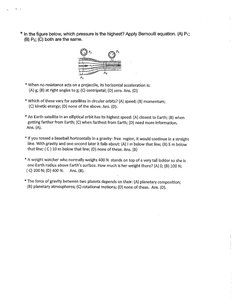
Bernoulli's Equation: Relates pressure, velocity, and height in a moving fluid. It is a statement of conservation of energy for flowing fluids.
Equation:
Used to explain lift in airplane wings and the operation of carburetors.
Heat and States of Matter
States of Matter
Matter exists in four primary states: solids, liquids, gases, and plasma. Each state is characterized by the arrangement and motion of its particles.
Solids: Definite shape and volume, particles vibrate in place.
Liquids: Definite volume, no definite shape, particles move past each other.
Gases: No definite shape or volume, particles move freely.
Plasma: Ionized gas with free electrons, found in stars.
Temperature and Thermometers
Temperature is a measure of the average kinetic energy of particles in a substance. Thermometers are devices used to measure temperature, often based on the expansion of fluids.
Fahrenheit and Celsius: Two common temperature scales. Water freezes at 0°C (32°F) and boils at 100°C (212°F).
Early thermometers used alcohol or mercury to indicate temperature changes.
Problem-Solving Examples
Sample Problems and Applications
The following are representative problems that test understanding of gravity, fluids, and heat concepts:
Atmospheric pressure and its causes
Application of the principle of continuity in fluid flow
Buoyancy and Archimedes' Principle in floating and sinking objects
Calculating pressure differences using Bernoulli's equation
Determining escape speed and orbital motion parameters
For example, to find the pressure at a certain depth in a fluid, use:
Where is atmospheric pressure at the surface, is fluid density, is gravity, and is depth.
Sample Multiple-Choice Questions
Practice questions cover topics such as:
Why atmospheric molecules do not escape into space
How pressure changes with depth in a fluid
Application of Bernoulli's equation to determine pressure differences
Factors affecting orbital speed and escape velocity
Summary Table: Key Fluid Principles
Principle | Equation | Main Application |
|---|---|---|
Pascal's Principle | Hydraulic lifts, brakes | |
Archimedes' Principle | Buoyancy, floating/sinking | |
Continuity Equation | Fluid flow in pipes | |
Bernoulli's Equation | Airplane wings, carburetors |
