 Back
BackPHY 106 Fundamentals of Physics – Syllabus and Course Structure Study Guide
Study Guide - Smart Notes
 Tailored notes based on your materials, expanded with key definitions, examples, and context.
Course Overview
Introduction to PHY 106: Fundamentals of Physics
PHY 106 is a foundational college physics course designed for nonscience liberal arts and technical students. The course covers essential physical principles and phenomena, including mechanics, properties of matter, heat, sound, electricity, magnetism, light, and quantum physics. It is structured to provide a broad understanding of physics concepts without requiring prior high school physics experience.
Course Title: Fundamentals of Physics
Course Number: PHY 106-300
Semester: Spring 2026
Credit Hours: 3
Contact Hours: 4
Prerequisite: One year of high school algebra
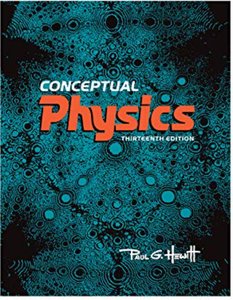
Textbook: Hewitt, Conceptual Physics, 13th Ed. (2021)
Major Course Concepts
Core Physics Topics
The course is organized around several major physics concepts, each corresponding to chapters in the textbook and weekly content. These topics are fundamental to understanding the physical world and are aligned with standard college physics curricula.
Motion, Vectors, Force, Torque, Energy, Power
Circular Motion and Gravitation
Moment of Inertia
Density, Pressure, Temperature, Heat Capacity, Gas Laws
Electric and Magnetic Fields
Electric Circuits, Waves, Sound, Light
Quantum Effects, Transducers, Computer Interfacing
Learning Outcomes
Skills and Knowledge Gained
Upon completion of PHY 106, students will be able to:
Describe the metric system of units.
Graphically sketch the resultant and components of vectors.
Distinguish between velocity and acceleration.
Explain and apply Newton's Laws of Motion.
Describe concepts of work, potential energy, and kinetic energy.
Understand the First and Second Laws of Thermodynamics.
Apply the Law of Energy Conservation to mechanical systems.
Classify and describe rotational motion using center of mass, torque, rotational inertia, and angular momentum.
Use Newton's Law of Gravitation for orbital motion.
Apply Archimedes' Law for buoyancy predictions.
Explain hydraulic systems using Pascal's Principle.
Describe barometers and atmospheric pressure measurement.
Apply Bernoulli's Principle in practical contexts.
Distinguish between temperature and heat.
Describe heat storage and transmission methods.
Calculate energy exchanges during phase and temperature changes.
Apply thermodynamic laws to mechanical systems.
Explain wave theory, superposition, standing waves, and the Doppler Effect.
Describe sound intensity, decibel system, and wave properties.
Describe the electromagnetic spectrum.
Explain the wave and quantum nature of light.
Describe light properties: emission, absorption, fluorescence, phosphorescence, laser operation.
Explain light phenomena: reflection, refraction, dispersion, scattering, diffraction, interference, polarization.
Describe electric and magnetic fields and their effects.
Apply Ohm's Law and the power law to D.C. circuits.
Course Structure and Assessment
Weekly Content and Exams
The course is divided into weekly modules, each covering specific chapters and topics. Students engage with lecture videos, PowerPoint presentations, discussions, homework, quizzes, and unit exams. All assessments are proctored online using Honorlock.
Weekly Homework: Completed online via Canvas.
Quizzes: Multiple-choice, based on homework, proctored with Honorlock.
Exams: Four unit exams and a final exam, covering major course concepts.
Participation: Weekly discussion posts required for participation points.
Grading Breakdown
Assessment Weighting
Assessment | Weight (%) |
|---|---|
Exam 1 | 10 |
Exam 2 | 10 |
Exam 3 | 10 |
Exam 4 | 10 |
Discussions | 5 |
Quizzes | 20 |
Homework | 15 |
Final Exam | 20 |
Letter Grade Scale:
Percentage | Letter Grade |
|---|---|
90-100% | A |
80-89% | B |
70-79% | C |
60-69% | D |
50-59% | F |
Academic Integrity
Department Policy and Code of Conduct
The Physical Science Department emphasizes the importance of academic integrity. Cheating and plagiarism are strictly prohibited, with clear consequences for violations. Students are expected to submit original work and uphold the college's core values: integrity, responsibility, respect, fairness, and diversity.
Cheating: Unauthorized assistance, information sharing, use of prohibited devices, or copying materials.
Plagiarism: Using another's work without acknowledgment, submitting work prepared by others, or recycling work without approval.
Sanctions: Zero on the assignment, potential 'F' for the course, and reporting to the Dean.
Course Calendar
Weekly Topics and Schedule
The course follows a structured calendar, with each week dedicated to specific chapters and concepts. Key topics include units and measurements, Newton's laws, momentum, rotation, properties of matter, thermodynamics, electromagnetism, light, quantum mechanics, and relativity.
Weeks 1-4: Introduction, Units, Measurements, Linear Motion, Newton's Laws, Momentum, Rotation
Weeks 5-8: Solids, Liquids, Gases, Temperature, Heat, Thermodynamics
Weeks 9-12: Electromagnetism, Magnetism, Induction, Electromagnetic Waves
Weeks 13-15: Quantum Mechanics, Relativity
Week 16: Final Exam
Student Support and Resources
General Information and Academic Support
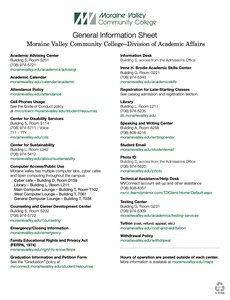
Students have access to a variety of academic resources, including advising, tutoring, and support centers. These resources are designed to help students succeed in their studies and maintain academic integrity.
Additional Information
Degree Completion and College Credentials
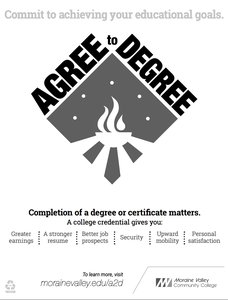
Completion of a degree or certificate at Moraine Valley Community College provides benefits such as greater earnings, a stronger resume, better job prospects, security, upward mobility, and personal satisfaction.
Additional info: The syllabus aligns closely with the standard college physics topics listed in the provided chapter titles, covering mechanics, thermodynamics, electromagnetism, light, quantum mechanics, and relativity. The course structure, learning outcomes, and assessment methods are typical for an introductory physics course designed for non-majors and technical students.
