
A uniform 2.00-m ladder of mass 9.00 kg is leaning against a vertical wall while making an angle of 53.0° with the floor. A worker pushes the ladder up against the wall until it is vertical. What is the increase in the gravitational potential energy of the ladder?
Find the moment of inertia of a hoop (a thin-walled, hollow ring) with mass M and radius R about an axis perpendicular to the hoop's plane at an edge.
Verified step by step guidance
Verified video answer for a similar problem:
Key Concepts
Moment of Inertia
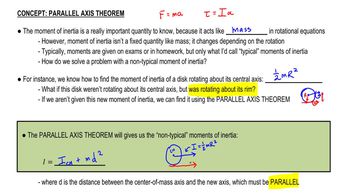
Parallel Axis Theorem
Geometry of the Hoop
If we multiply all the design dimensions of an object by a scaling factor f, its volume and mass will be multiplied by f3. By what factor will its moment of inertia be multiplied?
If we multiply all the design dimensions of an object by a scaling factor f, its volume and mass will be multiplied by f3. If a 1/48 scale model has a rotational kinetic energy of 2.5 J, what will be the kinetic energy for the full-scale object of the same material rotating at the same angular velocity?
A thin, rectangular sheet of metal has mass M and sides of length a and b. Use the parallel-axis theorem to calculate the moment of inertia of the sheet for an axis that is perpendicular to the plane of the sheet and that passes through one corner of the sheet.
A thin uniform rod of mass M and length L is bent at its center so that the two segments are now perpendicular to each other. Find its moment of inertia about an axis perpendicular to its plane and passing through the point where the two segments meet.
A slender rod with length L has a mass per unit length that varies with distance from the left end, where x = 0, according to dm/dx = γx, where γ has units of kg/m2. Use Eq. (9.20) to calculate the moment of inertia of the rod for an axis at the left end, perpendicular to the rod. Use the expression you derived in part (a) to express I in terms of M and L. How does your result compare to that for a uniform rod? Explain.
