Skip to main content
Precalculus
My Course
Learn
Exam Prep
AI Tutor
Study Guides
Flashcards
Explore
Try the app
My Course
Learn
Exam Prep
AI Tutor
Study Guides
Flashcards
Explore
Try the app
Back
Cofunctions of Complementary Angles quiz
You can tap to flip the card.
What is the definition of complementary angles?
You can tap to flip the card.
👆
What is the definition of complementary angles?
Complementary angles are two angles whose measures add up to 90 degrees.
Track progress
Control buttons has been changed to "navigation" mode.
1/15
Related flashcards
Related practice
Recommended videos
Cofunctions of Complementary Angles definitions
Cofunctions of Complementary Angles
15 Terms
Cofunctions of Complementary Angles
8. Trigonometric Functions on Right Triangles
3 problems
Topic
Solving Right Triangles
8. Trigonometric Functions on Right Triangles
5 problems
Topic
8. Trigonometric Functions on Right Triangles
4 topics
7 problems
Chapter
4:42
Using Cofunction Identities to Solve Equations
811
views
19
rank
6:30
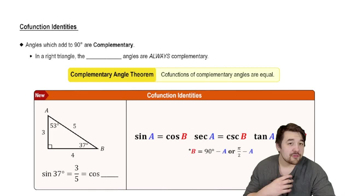
Cofunction Identities
1131
views
23
rank
2
comments
Terms in this set (15)
Hide definitions
What is the definition of complementary angles?
Complementary angles are two angles whose measures add up to 90 degrees.
In a right triangle, why are the two non-right angles always complementary?
Because the right angle is 90 degrees and the sum of all angles in a triangle is 180 degrees, the other two angles must add up to 90 degrees.
What does the complementary angle theorem state about cofunctions?
The complementary angle theorem states that cofunctions of complementary angles are equal.
What is a cofunction identity in trigonometry?
A cofunction identity describes how two trigonometric functions are related through their complementary angles.
What is the cofunction identity for sine and cosine?
The sine of an angle is equal to the cosine of its complement: sin(θ) = cos(90° - θ).
If sin(53°) = cos(37°), what is the relationship between 53° and 37°?
53° and 37° are complementary angles because they add up to 90°.
How do you find the cofunction of tan(16°)?
The cofunction of tan(16°) is cot(74°), since 74° is the complement of 16°.
What is the cofunction of sec(0°)?
The cofunction of sec(0°) is csc(90°).
How do you express cos(5π/18) in terms of its cofunction using radians?
cos(5π/18) = sin(π/2 - 5π/18), which simplifies to sin(2π/9).
What is the general formula for finding the cofunction of an angle θ in degrees?
The cofunction of an angle θ is the corresponding cofunction evaluated at (90° - θ).
How do you use cofunction identities to solve an equation like sin(x - 10) = cos(x)?
Rewrite cos(x) as sin(90° - x), then set the arguments equal: x - 10 = 90 - x, and solve for x.
What is the solution for x in the equation sin(x - 10) = cos(x)?
x = 50.
When solving cos(θ) = sin(2θ - 30), what is the first step using cofunction identities?
Rewrite cos(θ) as sin(90° - θ) so both sides have the same trigonometric function.
After rewriting cos(θ) = sin(2θ - 30) as sin(90° - θ) = sin(2θ - 30), what do you do next?
Set the arguments equal: 90 - θ = 2θ - 30, and solve for θ.
What is the value of θ that solves cos(θ) = sin(2θ - 30)?
θ = 40 degrees.
 BackBack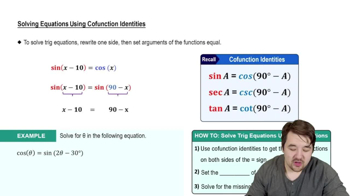
 4:42
4:42