Skip to main content
Precalculus
My Course
Learn
Exam Prep
AI Tutor
Study Guides
Flashcards
Explore
Try the app
My Course
Learn
Exam Prep
AI Tutor
Study Guides
Flashcards
Explore
Try the app
Back
Combinatorics quiz
You can tap to flip the card.
What does the fundamental counting principle state about finding the total number of outcomes for multiple choices?
You can tap to flip the card.
👆
What does the fundamental counting principle state about finding the total number of outcomes for multiple choices?
It states that you multiply the number of choices for each option to get the total number of outcomes.
Track progress
Control buttons has been changed to "navigation" mode.
1/15
Related flashcards
Related practice
Recommended videos
Combinatorics definitions
Combinatorics
15 Terms
Combinatorics
21. Combinatorics and Probability
5 problems
Topic
Probability
21. Combinatorics and Probability
4 problems
Topic
21. Combinatorics and Probability
3 topics
5 problems
Chapter
Guided course
06:37
Permutations of Non-Distinct Objects
332
views
3
rank
Guided course
07:11
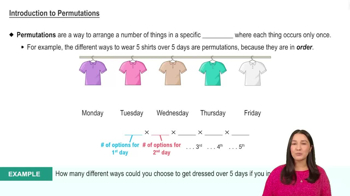
Introduction to Permutations
405
views
3
rank
Guided course
03:18
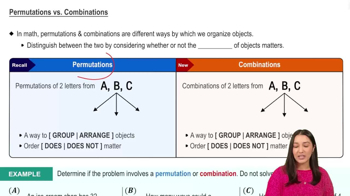
Permutations vs. Combinations
356
views
4
rank
Terms in this set (15)
Hide definitions
What does the fundamental counting principle state about finding the total number of outcomes for multiple choices?
It states that you multiply the number of choices for each option to get the total number of outcomes.
How many possible outfits can you make with 3 shirts and 4 pairs of pants?
You can make 12 possible outfits by multiplying 3 shirts by 4 pants.
If a menu has 4 appetizers and 6 entrees, how many different meals with both can you choose?
There are 24 different meals, found by multiplying 4 appetizers by 6 entrees.
How does the fundamental counting principle apply to more than two events?
You continue multiplying the number of options for each event to get the total number of outcomes.
What is a permutation and when is it used?
A permutation is an arrangement of distinct objects where the order matters.
What is the formula for the number of permutations of n objects taken r at a time?
The formula is n! divided by (n - r)!, or n!/(n - r)!
How do you adjust the permutations formula for non-distinct (identical) objects?
You divide n! by the factorial of each type of identical object, so n!/(r1! * r2! * ...).
How many different 8-digit codes can be made from 5 zeros and 3 ones?
There are 56 different codes, calculated as 8!/(5! * 3!).
How many ways can you arrange the letters in the word 'banana'?
There are 60 ways, found by 6!/(1! * 3! * 2!).
What is the key difference between permutations and combinations?
In permutations, order matters; in combinations, order does not matter.
If you select 2 flavors from 32 to blend into a milkshake, is this a permutation or a combination and why?
It is a combination because the order of the flavors does not matter.
What is the formula for the number of combinations of n objects taken r at a time?
The formula is n! divided by (n - r)! times r!, or n!/(n - r)!r!.
How many different teams of 4 people can be formed from a group of 9?
There are 126 teams, calculated as 9!/(5! * 4!).
How do you determine whether to use a permutation or a combination for a problem?
Ask if the order of selection matters; if yes, use permutations, if no, use combinations.
What is the value of 5 factorial (5!) and what does it represent in counting problems?
5! equals 120 and represents the number of ways to arrange 5 distinct objects in order.
 BackBack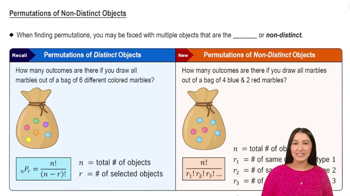
 06:37
06:37