Skip to main content
Precalculus
My Course
Learn
Exam Prep
AI Tutor
Study Guides
Flashcards
Explore
Try the app
My Course
Learn
Exam Prep
AI Tutor
Study Guides
Flashcards
Explore
Try the app
Back
Complementary and Supplementary Angles quiz
You can tap to flip the card.
What is the sum of two complementary angles?
You can tap to flip the card.
👆
What is the sum of two complementary angles?
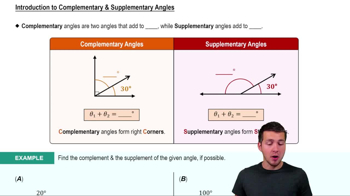
The sum of two complementary angles is 90 degrees.
Track progress
Control buttons has been changed to "navigation" mode.
1/15
Related flashcards
Related practice
Recommended videos
Complementary and Supplementary Angles definitions
Complementary and Supplementary Angles
14 Terms
Complementary and Supplementary Angles
7. Measuring Angles
7 problems
Topic
Radians
7. Measuring Angles
3 problems
Topic
7. Measuring Angles
4 topics
8 problems
Chapter
2:28
Solving Problems with Complementary & Supplementary Angles
1473
views
58
rank
3:04
Example 1
1329
views
86
rank
3:35
Intro to Complementary & Supplementary Angles
2344
views
63
rank
Terms in this set (15)
Hide definitions
What is the sum of two complementary angles?
The sum of two complementary angles is 90 degrees.
What is the sum of two supplementary angles?
The sum of two supplementary angles is 180 degrees.
How do you find the complement of a 30-degree angle?
Subtract 30 from 90; the complement is 60 degrees.
How do you find the supplement of a 30-degree angle?
Subtract 30 from 180; the supplement is 150 degrees.
What is the complement of a 20-degree angle?
The complement is 70 degrees, since 90 - 20 = 70.
What is the supplement of a 20-degree angle?
The supplement is 160 degrees, since 180 - 20 = 160.
Does a 100-degree angle have a complement?
No, because its complement would be negative, which is not allowed.
What is the supplement of a 100-degree angle?
The supplement is 80 degrees, since 180 - 100 = 80.
In a right triangle, what is the relationship between the two non-right angles?
The two non-right angles are complementary and add up to 90 degrees.
If two angles are x and x + 10 and are complementary, what equation can you set up?
You can set up the equation x + (x + 10) = 90.
If x + (x + 10) = 90, what is the value of x?
x = 40, since 2x + 10 = 90 leads to 2x = 80, so x = 40.
What are the measures of the two complementary angles if one is x and the other is x + 10?
The angles are 40 degrees and 50 degrees.
What mnemonic can help you remember complementary and supplementary angles?
Complementary angles form corners (C with C), and supplementary angles form straight lines (S with S).
What do you do if an angle is given as a variable and you need to find its complement or supplement?
Set up an equation where the sum equals 90 for complement or 180 for supplement, then solve for the variable.
Why can't angles greater than 90 degrees have a complement?
Because their complement would be negative, which is not a valid angle measure.
 BackBack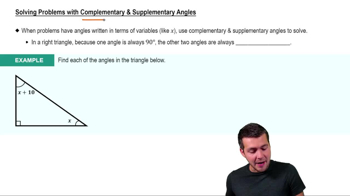
 2:28
2:28