Skip to main content
Precalculus
My Course
Learn
Exam Prep
AI Tutor
Study Guides
Flashcards
Explore
Try the app
My Course
Learn
Exam Prep
AI Tutor
Study Guides
Flashcards
Explore
Try the app
Back
Determinants and Cramer's Rule quiz
You can tap to flip the card.
How do you calculate the determinant of a 2x2 matrix [[a, b], [c, d]]?
You can tap to flip the card.
👆
How do you calculate the determinant of a 2x2 matrix [[a, b], [c, d]]?
Multiply a by d, multiply b by c, and subtract: ad - bc.
Track progress
Control buttons has been changed to "navigation" mode.
1/15
Related flashcards
Related practice
Recommended videos
Determinants and Cramer's Rule definitions
Determinants and Cramer's Rule
15 Terms
Determinants and Cramer's Rule
18. Systems of Equations and Matrices
6 problems
Topic
Graphing Systems of Inequalities
18. Systems of Equations and Matrices
6 problems
Topic
18. Systems of Equations and Matrices
4 topics
10 problems
Chapter
4:36
Determinants of 2×2 Matrices
623
views
7
rank
7:25
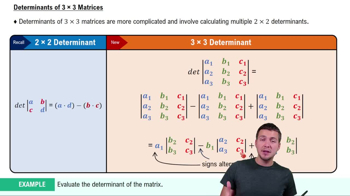
Determinants of 3×3 Matrices
441
views
9
rank
6:54
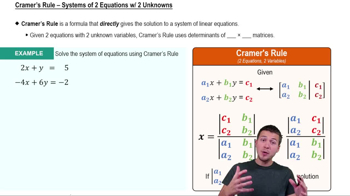
Cramer's Rule - 2 Equations with 2 Unknowns
522
views
16
rank
Terms in this set (15)
Hide definitions
How do you calculate the determinant of a 2x2 matrix [[a, b], [c, d]]?
Multiply a by d, multiply b by c, and subtract: ad - bc.
What is the determinant of the matrix [[8, 4], [5, 0]]?
The determinant is 8*0 - 4*5 = -20.
What is the general formula for the determinant of a 2x2 matrix?
The formula is ad - bc for a matrix [[a, b], [c, d]].
How do you handle negative numbers when calculating determinants?
Multiply as usual and be careful with the signs; subtracting a negative is the same as adding.
What does Cramer's Rule allow you to do with systems of equations?
Cramer's Rule lets you solve systems of equations by calculating determinants and plugging them into a formula.
When using Cramer's Rule for two equations, how do you set up the matrices for x and y?
Replace the x or y column with the constants column to form new matrices for each variable.
What is the determinant of the matrix [[-3, 1], [-7, -2]]?
The determinant is (-3)*(-2) - 1*(-7) = 6 + 7 = 13.
How do you calculate the determinant of a 3x3 matrix?
Expand along the first row, multiplying each entry by the determinant of the 2x2 matrix left after removing its row and column, and alternate signs.
What is the sign pattern when expanding a 3x3 determinant along the first row?
The signs alternate: +, -, +.
In Cramer's Rule for three variables, what does the denominator determinant (D) represent?
It is the determinant of the coefficient matrix for x, y, and z.
How do you form the numerator determinant for x (Dx) in a 3x3 system using Cramer's Rule?
Replace the x column in the coefficient matrix with the constants column, then calculate the determinant.
What do you do if the denominator determinant (D) is zero when using Cramer's Rule?
If D is zero, the system has no unique solution.
How do you calculate the value of y using Cramer's Rule in a 3x3 system?
Replace the y column with the constants column, calculate the determinant (Dy), and divide by D: y = Dy/D.
What is the solution to the system if Dx = -15 and D = -3?
x = Dx/D = -15 / -3 = 5.
Why is it important to be careful with negative signs when calculating determinants?
Because incorrect handling of negative signs can lead to wrong answers, especially when subtracting products.
 BackBack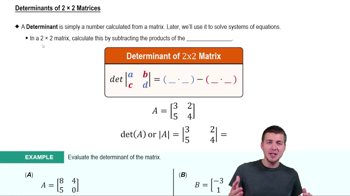
 4:36
4:36