Skip to main content
Precalculus
My Course
Learn
Exam Prep
AI Tutor
Study Guides
Flashcards
Explore
Try the app
My Course
Learn
Exam Prep
AI Tutor
Study Guides
Flashcards
Explore
Try the app
Back
Eliminate the Parameter quiz
You can tap to flip the card.
What does it mean to eliminate the parameter in parametric equations?
You can tap to flip the card.
👆
What does it mean to eliminate the parameter in parametric equations?
It means to remove the variable t from the equations, leaving an equation that only involves x and y.
Track progress
Control buttons has been changed to "navigation" mode.
1/15
Related flashcards
Related practice
Recommended videos
Eliminate the Parameter definitions
Eliminate the Parameter
15 Terms
Eliminate the Parameter
16. Parametric Equations
3 problems
Topic
Writing Parametric Equations
16. Parametric Equations
3 problems
Topic
16. Parametric Equations
3 topics
2 problems
Chapter
04:39
Equations with Trigonometric Functions Example 3
339
views
7
rank
05:59
Eliminating the Parameter
521
views
9
rank
04:11
Equations with Trigonometric Functions
354
views
7
rank
Terms in this set (15)
Hide definitions
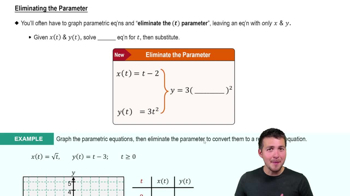
What does it mean to eliminate the parameter in parametric equations?
It means to remove the variable t from the equations, leaving an equation that only involves x and y.
What is the typical process for eliminating the parameter in parametric equations?
Solve one equation for t and substitute it into the other equation.
Why is it usually better to solve the x equation for t and substitute into the y equation?
This often results in a more familiar equation, such as a line or parabola, involving only x and y.
Given x = √t and y = t - 3, what is the rectangular equation after eliminating the parameter?
The rectangular equation is y = x² - 3.
Why are t values sometimes restricted in parametric equations?
Restrictions on t prevent undefined or imaginary values, such as negative values under a square root.
What effect do restrictions on t have on the graph of a parametric equation?
They limit the portion of the graph represented, so only part of the full rectangular equation is shown.
What familiar shape does the equation y = x² - 3 represent?
It represents a parabola.
What is a rectangular equation?
A rectangular equation is an equation involving only x and y, with no parameter t.
What is the main challenge when eliminating the parameter in parametric equations involving trigonometric functions?
Direct substitution can lead to complicated expressions, so a different strategy is needed.
What identity is used to eliminate the parameter in parametric equations with sine and cosine?
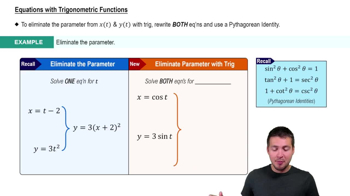
The Pythagorean identity sin²(t) + cos²(t) = 1 is used.
Given x = cos(t) and y = 3sin(t), what are the expressions for cos(t) and sin(t)?
cos(t) = x and sin(t) = y/3.
How do you use the Pythagorean identity to eliminate the parameter in x = cos(t) and y = 3sin(t)?
Substitute x for cos(t) and y/3 for sin(t) into the identity, resulting in x² + (y/3)² = 1.
What type of conic section does the equation x² + (y/3)² = 1 represent?
It represents an ellipse.
What is the general method for eliminating the parameter in parametric equations with trig functions?
Solve each equation for the trig function, square them, and use a Pythagorean identity to relate them.
Why does the graph of a parametric equation sometimes only show part of the full rectangular graph?
Because the range of t is restricted, so only a segment of the full graph is plotted.
 BackBack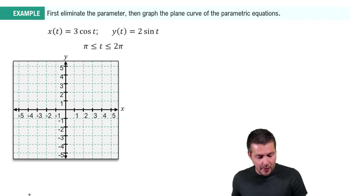
 04:39
04:39