Skip to main content
Precalculus
My Course
Learn
Exam Prep
AI Tutor
Study Guides
Flashcards
Explore
Try the app
My Course
Learn
Exam Prep
AI Tutor
Study Guides
Flashcards
Explore
Try the app
Back
Function Operations quiz
You can tap to flip the card.
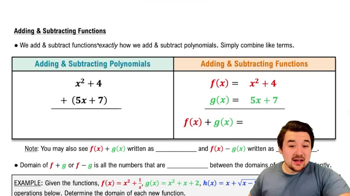
How do you add two functions, such as f(x) = x^2 + 4 and g(x) = 5x + 7?
You can tap to flip the card.
👆
How do you add two functions, such as f(x) = x^2 + 4 and g(x) = 5x + 7?
You add the corresponding terms to get x^2 + 5x + 11.
Track progress
Control buttons has been changed to "navigation" mode.
1/15
Related flashcards
Related practice
Recommended videos
Function Operations definitions
Function Operations
15 Terms
Function Operations
3. Functions & Graphs
2 problems
Topic
Function Composition
3. Functions & Graphs
7 problems
Topic
3. Functions & Graphs
5 topics
9 problems
Chapter
7:24
Multiplying & Dividing Functions
1445
views
47
rank
2
comments
4:46
Adding & Subtracting Functions Example 1
1481
views
46
rank
1
comments
5:56
Adding & Subtracting Functions
2111
views
43
rank
1
comments
Terms in this set (15)
Hide definitions
How do you add two functions, such as f(x) = x^2 + 4 and g(x) = 5x + 7?
You add the corresponding terms to get x^2 + 5x + 11.
What is the domain of the sum or difference of two functions?
It is the intersection of the domains of the individual functions, considering any restrictions like division by zero.
What restriction must you consider when a function has a denominator of x?
x cannot be equal to 0 because division by zero is undefined.
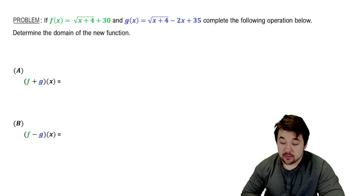
How do you subtract h(x) = x + sqrt(x-8) from g(x) = x^2 + x + 2?
You distribute the negative sign and combine like terms to get x^2 + 2 - sqrt(x-8).
What is the domain of h(x) = x + sqrt(x-8)?
x must be greater than or equal to 8 because the expression under the square root cannot be negative.
When multiplying f(x) = sqrt(x) and g(x) = 3x - 6, what is the resulting function?
The result is 3x*sqrt(x) - 6*sqrt(x).
What is the domain of f(x) = sqrt(x)?
The domain is all real numbers x such that x ≥ 0.
What additional restriction must you consider when dividing functions?
The denominator cannot be zero, so any x that makes the denominator zero must be excluded from the domain.
If f(x) = sqrt(x) and g(x) = 3x - 6, what is the domain of f(x)/g(x)?
The domain is x ≥ 0 and x ≠ 2, since 3x - 6 = 0 when x = 2.
How do you multiply f(x) = x^2 - 4 and g(x) = x + 2?
Use the distributive property (FOIL) to get x^3 + 2x^2 - 4x - 8.
What is the domain of the product of two polynomials?
The domain is all real numbers, since polynomials are defined everywhere.
How do you divide f(x) = x^2 - 4 by g(x) = x + 2 and simplify?
Factor the numerator to (x + 2)(x - 2), cancel x + 2, and get x - 2, but x ≠ -2.
Why must you find domain restrictions before simplifying a division of functions?
Because simplification can remove factors that cause restrictions, but the original domain restrictions still apply.
What does the notation (f + g)(x) mean?
It means f(x) + g(x), the sum of the two functions evaluated at x.
What does the notation (f/g)(x) mean?
It means f(x) divided by g(x), with the domain restricted so that g(x) ≠ 0.
 BackBack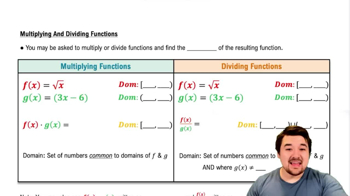
 7:24
7:24