Skip to main content
Precalculus
My Course
Learn
Exam Prep
AI Tutor
Study Guides
Flashcards
Explore
Try the app
My Course
Learn
Exam Prep
AI Tutor
Study Guides
Flashcards
Explore
Try the app
Back
Intro to Functions & Their Graphs quiz
You can tap to flip the card.
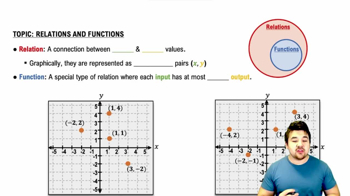
What is the main difference between a relation and a function?
You can tap to flip the card.
👆
What is the main difference between a relation and a function?
A function is a special type of relation where each input has at most one output; not all relations are functions.
Track progress
Control buttons has been changed to "navigation" mode.
1/15
Related flashcards
Related practice
Recommended videos
Intro to Functions & Their Graphs definitions
Intro to Functions & Their Graphs
15 Terms
Intro to Functions & Their Graphs
3. Functions & Graphs
6 problems
Topic
Common Functions
3. Functions & Graphs
3 problems
Topic
3. Functions & Graphs
5 topics
9 problems
Chapter
5:10
Finding the Domain and Range of a Graph
3199
views
123
rank
1
comments
5:38
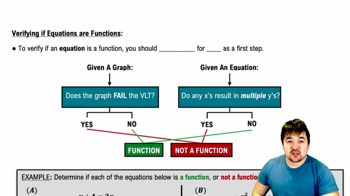
Verifying if Equations are Functions
3530
views
146
rank
3
comments
5:20
Relations and Functions
7347
views
290
rank
Terms in this set (15)
Hide definitions
What is the main difference between a relation and a function?
A function is a special type of relation where each input has at most one output; not all relations are functions.
How can you visually determine if a graph represents a function?
You can use the vertical line test: if any vertical line passes through more than one point on the graph, it is not a function.
What does it mean if an input in a relation has more than one output?
It means the relation is not a function because functions require each input to have at most one output.
What is the first step when verifying if an equation is a function?
The first step is to solve the equation for y.
What do you check for after solving an equation for y to determine if it is a function?
You check if any x-value results in multiple y-values; if so, it is not a function.
Are all linear equations of the form y = mx + b functions?
Yes, all linear equations with a defined slope are functions because each x-value gives exactly one y-value.
What does the notation f(x) represent in function notation?
f(x) replaces y and represents the output of the function for a given input x.
How do you find the domain of a function from its graph?
Squish the graph down to the x-axis; the resulting interval shows the domain.
How do you find the range of a function from its graph?
Squish the graph down to the y-axis; the resulting interval shows the range.
What does a closed dot or solid line on a graph indicate about domain or range?
A closed dot or solid line means the endpoint is included in the domain or range.
What does an open circle on a graph indicate about domain or range?
An open circle means the endpoint is not included in the domain or range.
What are the two common notations for expressing domain and range?
Domain and range can be expressed using interval notation or set builder notation.
What restriction is placed on the domain when x is inside a square root?
The domain is restricted to values where the inside of the square root is not negative.
What restriction is placed on the domain when x is in the denominator of a fraction?
The domain excludes any x-values that make the denominator zero.
How do you express the domain of f(x) = 2/(x-5) in interval notation?
The domain is (-∞, 5) ∪ (5, ∞), meaning all real numbers except x = 5.
 BackBack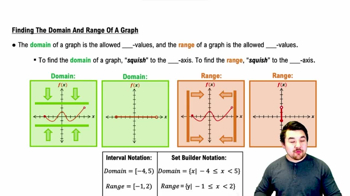
 5:10
5:10