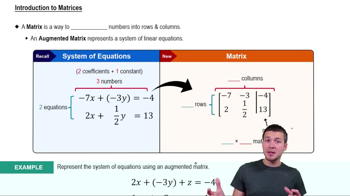
A matrix is a way to organize numbers into a grid with rows and columns. Each entry is identified by its row and column position.
How do you describe the size of a matrix?
The size of a matrix is described by the number of rows by the number of columns, such as a 2 by 3 matrix.
What is an augmented matrix?
An augmented matrix represents a system of equations by copying the coefficients and constants into a matrix, with a vertical line separating the constants.
When converting a system of equations to a matrix, what do you do if a variable is missing in an equation?
If a variable is missing, you write a 0 in its place in the matrix to indicate its coefficient is zero.
What are the three main row operations you can perform on a matrix?
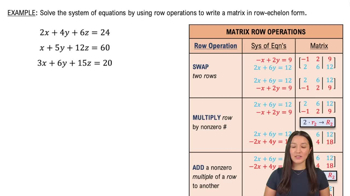
The three main row operations are swapping two rows, multiplying a row by a non-zero number, and adding a multiple of one row to another.
Why can't you multiply a row by zero in a matrix?
Multiplying a row by zero would effectively delete the equation, which is not allowed in solving systems.
What does swapping two rows in a matrix correspond to in a system of equations?
Swapping two rows in a matrix is the same as swapping the positions of two equations in a system.
What is row echelon form?
Row echelon form is when a matrix has ones along the diagonal and zeros below the diagonal, making back substitution easier.
What is reduced row echelon form?
Reduced row echelon form has ones along the diagonal and zeros both above and below the diagonal, so no further work is needed after converting back to equations.
What is Gaussian elimination?
Gaussian elimination is the process of using row operations to bring a matrix to row echelon form.
What is Gauss-Jordan elimination?
Gauss-Jordan elimination is the process of using row operations to bring a matrix to reduced row echelon form.
Why do we use row operations on matrices?
We use row operations to systematically simplify the matrix, making it easier to solve the corresponding system of equations.
When trying to get zeros in a matrix, which row operation is typically used?
To get zeros in a matrix, you typically add a multiple of one row to another.
What is the advantage of reduced row echelon form over row echelon form?
Reduced row echelon form allows you to read the solutions directly from the matrix without needing back substitution.
What does the vertical line in an augmented matrix represent?
The vertical line in an augmented matrix represents the equality sign, separating the coefficients from the constants.
 Back
Back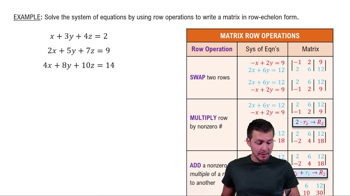
 13:06
13:06