Skip to main content
Precalculus
My Course
Learn
Exam Prep
AI Tutor
Study Guides
Flashcards
Explore
Try the app
My Course
Learn
Exam Prep
AI Tutor
Study Guides
Flashcards
Explore
Try the app
Back
Phase Shifts quiz
You can tap to flip the card.
What is a phase shift in the context of sine and cosine graphs?
You can tap to flip the card.
👆
What is a phase shift in the context of sine and cosine graphs?
A phase shift is a horizontal shift of the sine or cosine graph, moving it left or right.
Track progress
Control buttons has been changed to "navigation" mode.
1/15
Related flashcards
Related practice
Recommended videos
Phase Shifts definitions
Phase Shifts
15 Terms
Phase Shifts
10. Graphing Trigonometric Functions
3 problems
Topic
Graphs of Secant and Cosecant Functions
10. Graphing Trigonometric Functions
3 problems
Topic
10. Graphing Trigonometric Functions
4 topics
7 problems
Chapter
6:31
Phase Shifts
1498
views
19
rank
1
comments
3:42
Example 1
801
views
31
rank
Terms in this set (15)
Hide definitions
What is a phase shift in the context of sine and cosine graphs?
A phase shift is a horizontal shift of the sine or cosine graph, moving it left or right.
How does subtracting a number from x inside a sine or cosine function affect the graph?
Subtracting a number from x shifts the graph to the right by that amount.
How does adding a number to x inside a sine or cosine function affect the graph?
Adding a number to x shifts the graph to the left by that amount.
What is the general formula to determine the amount of phase shift in y = sin(bx ± h) or y = cos(bx ± h)?
The phase shift is h divided by b, or h/b.
If you have y = cos(x - π/2), how is the graph shifted?
The graph is shifted to the right by π/2 units.
What is the period of a sine or cosine function y = sin(bx) or y = cos(bx)?
The period is 2π divided by b, or 2π/b.
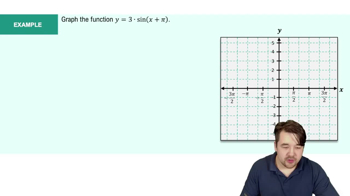
For y = sin(2x + π), in which direction and by how much is the graph shifted?
The graph is shifted to the left by π/2 units.
How can a phase shift make a cosine graph resemble a sine graph?
A phase shift can align the peaks and zeros of the cosine graph with those of the sine graph, making them look similar.
What does the value of b in y = sin(bx ± h) or y = cos(bx ± h) affect?
The value of b affects the period of the graph.
If the inside of the function is bx - h, which direction does the graph shift?
The graph shifts to the right by h/b units.
If the inside of the function is bx + h, which direction does the graph shift?
The graph shifts to the left by h/b units.
How do you rewrite y = sin(2x + π) to make the phase shift more apparent?
You can rewrite it as y = sin[2(x + π/2)], showing a shift left by π/2 units.
What happens to the starting point of the graph when a phase shift is applied?
The starting point moves horizontally by the phase shift amount.
Why is understanding phase shifts important when graphing trigonometric functions?
Understanding phase shifts helps accurately graph and analyze the behavior of sine and cosine functions.
What is the effect of the coefficient b on the graph of y = sin(bx) or y = cos(bx)?
The coefficient b changes the period of the graph, making it stretch or compress horizontally.
 BackBack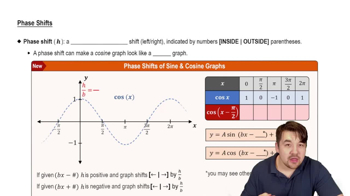
 6:31
6:31