Precalculus
My Course
Learn
Exam Prep
AI Tutor
Study Guides
Flashcards
Explore
My Course
Learn
Exam Prep
AI Tutor
Study Guides
Flashcards
Explore
Back
Polar Coordinate System quiz
You can tap to flip the card.
Define:
In polar coordinates, what does the variable r represent?
You can tap to flip the card.
👆
In polar coordinates, what does the variable r represent?
r represents the distance from the pole (origin) to the point.
Track progress
Control buttons has been changed to "navigation" mode.
1/15
Related flashcards
Related practice
Recommended videos
Polar Coordinate System definitions
Polar Coordinate System
15 Terms
Polar Coordinate System
15. Polar Equations
5 problems
Topic
Convert Points Between Polar and Rectangular Coordinates
15. Polar Equations
3 problems
Topic
15. Polar Equations
3 topics
5 problems
Chapter
Guided course
5:32
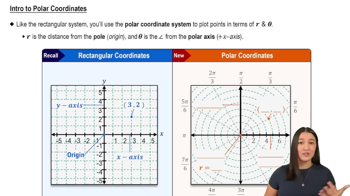
Intro to Polar Coordinates
Patrick
754
views
22
rank
Guided course
2:13
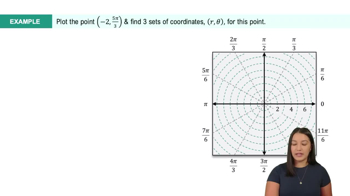
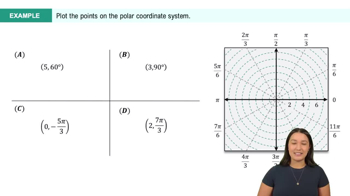
Intro to Polar Coordinates Example 1
Patrick
518
views
8
rank
Guided course
6:02
Determining Different Coordinates for the Same Point
Patrick
516
views
13
rank
Terms in this set (15)
Hide definitions
In polar coordinates, what does the variable r represent?
r represents the distance from the pole (origin) to the point.
How is the angle theta measured in the polar coordinate system?
Theta is measured counterclockwise from the polar axis, which is equivalent to the positive x-axis.
What is the pole in the context of polar coordinates?
The pole is the center point of the polar coordinate system, located at r = 0.
When plotting a point (r, θ) in polar coordinates, which value should you locate first?
You should locate the angle theta first, then count r units from the pole.
How do you plot a point with a negative theta value in polar coordinates?
A negative theta value means you measure the angle clockwise from the polar axis.
What should you do if the r value is negative when plotting a point in polar coordinates?
If r is negative, count r units in the direction opposite to the angle theta.
How can multiple ordered pairs represent the same point in polar coordinates?
By adding or subtracting multiples of 2π to theta or by changing r to negative and adding π to theta, you can get different pairs for the same point.
What is the effect of adding 2π to the angle theta in a polar coordinate pair?
Adding 2π to theta results in the same direction, so the point remains unchanged.
If you change r to its negative value, what must you do to theta to represent the same point?
You must add π to theta when you make r negative to represent the same point.
What is the ordered pair format for polar coordinates?
Polar coordinates are written as (r, theta), where r is the radius and theta is the angle.
How do you find coterminal angles in polar coordinates?
Coterminal angles are found by adding or subtracting multiples of 2π to the original angle theta.
What happens if you plot (r, θ) and (r, θ + 2πn) for any integer n?
Both ordered pairs represent the same point in polar coordinates.
Why must you be careful when changing the sign of r in polar coordinates?
Because you must also add π to theta to ensure the new pair represents the same point.
What does a negative r value indicate about the direction from the pole?
A negative r value means you move in the direction opposite to the angle theta.
How can you verify that two polar coordinate pairs represent the same point?
Plot both pairs on the polar grid and check if they end up at the same location.