Skip to main content
Precalculus
My Course
Learn
Exam Prep
AI Tutor
Study Guides
Flashcards
Explore
Try the app
My Course
Learn
Exam Prep
AI Tutor
Study Guides
Flashcards
Explore
Try the app
Back
Reciprocal Trigonometric Functions on the Unit Circle quiz
You can tap to flip the card.
What is the definition of the cosecant function in terms of sine?
You can tap to flip the card.
👆
What is the definition of the cosecant function in terms of sine?
Cosecant is defined as 1 divided by the sine of an angle.
Track progress
Control buttons has been changed to "navigation" mode.
1/15
Related flashcards
Related practice
Recommended videos
Reciprocal Trigonometric Functions on the Unit Circle definitions
Reciprocal Trigonometric Functions on the Unit Circle
14 Terms
Reciprocal Trigonometric Functions on the Unit Circle
9. Unit Circle
3 problems
Topic
Reference Angles
9. Unit Circle
5 problems
Topic
9. Unit Circle
5 topics
10 problems
Chapter
Guided course
3:23
Secant, Cosecant, & Cotangent on the Unit Circle
1478
views
37
rank
Terms in this set (15)
Hide definitions
What is the definition of the cosecant function in terms of sine?
Cosecant is defined as 1 divided by the sine of an angle.
How do you find the cosecant of an angle using the unit circle?
You take 1 divided by the y-value at that angle on the unit circle.
What is the definition of the secant function in terms of cosine?
Secant is defined as 1 divided by the cosine of an angle.
How do you find the secant of an angle using the unit circle?
You take 1 divided by the x-value at that angle on the unit circle.
What is the definition of the cotangent function in terms of tangent?
Cotangent is defined as 1 divided by the tangent of an angle.
How do you find the cotangent of an angle using the unit circle?
You divide the x-value by the y-value at that angle on the unit circle.
What is the value of the cosecant of π/6?
The cosecant of π/6 is 2.
What is the value of the cotangent of π/4?
The cotangent of π/4 is 1.
What is the value of the secant of 0?
The secant of 0 is 1.
If the sine of an angle is 1/2, what is its cosecant?
The cosecant is 2, since 1 divided by 1/2 equals 2.
If the x and y values at an angle are equal, what is the cotangent of that angle?
The cotangent is 1, because x divided by y equals 1.
Why are cosecant, secant, and cotangent called reciprocal functions?
They are each the reciprocal of sine, cosine, and tangent, respectively.
How can you use the unit circle to find reciprocal trig functions without memorizing new values?
You use the existing x and y values on the unit circle and apply the reciprocal definitions.
What is the formula for cotangent in terms of x and y on the unit circle?
Cotangent is x divided by y.
What is the relationship between the secant function and the x-coordinate on the unit circle?
Secant is the reciprocal of the x-coordinate, or 1/x.
 BackBack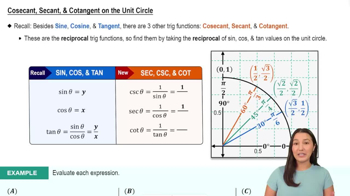
 3:23
3:23