Skip to main content
Precalculus
My Course
Learn
Exam Prep
AI Tutor
Study Guides
Flashcards
Explore
Try the app
My Course
Learn
Exam Prep
AI Tutor
Study Guides
Flashcards
Explore
Try the app
Back
Sum and Difference Identities quiz
You can tap to flip the card.
What is the sum identity for sine, sin(a + b)?
You can tap to flip the card.
👆
What is the sum identity for sine, sin(a + b)?
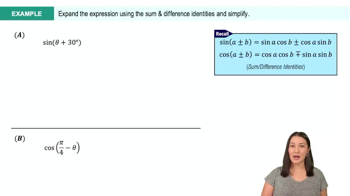
sin(a + b) = sin(a)cos(b) + cos(a)sin(b).
Track progress
Control buttons has been changed to "navigation" mode.
1/15
Related flashcards
Related practice
Recommended videos
Sum and Difference Identities definitions
Sum and Difference Identities
15 Terms
Sum and Difference Identities
12. Trigonometric Identities
5 problems
Topic
Double Angle Identities
12. Trigonometric Identities
4 problems
Topic
12. Trigonometric Identities
4 topics
8 problems
Chapter
Guided course
4:47
Sum and Difference of Tangent
1035
views
19
rank
Guided course
2:42
Sum and Difference of Sine & Cosine Example 3
886
views
26
rank
Guided course
06:14
Sum and Difference of Sine & Cosine
1887
views
62
rank
1
comments
Terms in this set (15)
Hide definitions
What is the sum identity for sine, sin(a + b)?
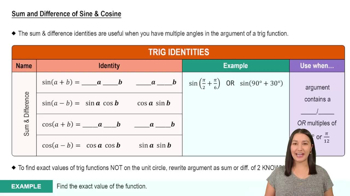
sin(a + b) = sin(a)cos(b) + cos(a)sin(b).
What is the difference identity for sine, sin(a - b)?
sin(a - b) = sin(a)cos(b) - cos(a)sin(b).
What is the sum identity for cosine, cos(a + b)?
cos(a + b) = cos(a)cos(b) - sin(a)sin(b).
What is the difference identity for cosine, cos(a - b)?
cos(a - b) = cos(a)cos(b) + sin(a)sin(b).
What is the sum identity for tangent, tan(a + b)?
tan(a + b) = (tan(a) + tan(b)) / (1 - tan(a)tan(b)).
What is the difference identity for tangent, tan(a - b)?
tan(a - b) = (tan(a) - tan(b)) / (1 + tan(a)tan(b)).
How can you find the exact value of cos(15°) using sum and difference identities?
Rewrite 15° as 45° - 30°, then use the cosine difference identity to expand and evaluate.
When should you use sum and difference identities to evaluate trig functions?
Use them when the argument contains a plus or minus, or when the angle is a multiple of 15° or π/12 radians.
What should you do if the tangent of an angle in the sum or difference identity is undefined?
Rewrite the tangent expression as sine over cosine and use the sum and difference identities for sine and cosine instead.
What is the first step when given trig values (not angles) and asked to evaluate a sum or difference?
Expand the relevant sum or difference identity and identify any unknown trig values.
How do you find missing trig values when only some are given and the angles are in specific quadrants?
Draw right triangles in the correct quadrants, label sides using the given values, and use the Pythagorean theorem to find missing sides.
Why is it important to pay attention to the sign of side lengths when drawing triangles in different quadrants?
Because the sign of the trig function depends on the quadrant, and incorrect signs can lead to wrong answers.
How do you verify a trig identity using sum and difference identities?
Start with the more complicated side, expand using the appropriate identity, and simplify until both sides are equal.
What is the value of cos(π/2 - θ) using sum and difference identities?
cos(π/2 - θ) = sin(θ).
What is the final answer for sin(a + b) if cos(a) = 4/5 (a in quadrant IV) and sin(b) = 5/13 (b in quadrant II)?
sin(a + b) = 56/65 after finding all missing values and simplifying.
 BackBack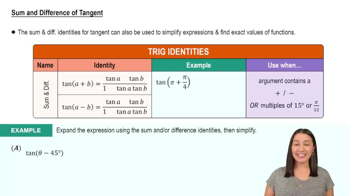
 4:47
4:47