A learning process where a neutral item acquires the ability to elicit a response after being paired with a stimulus that naturally brings about that response.
Little Albert Experiment
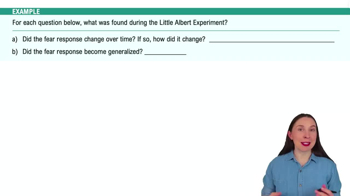
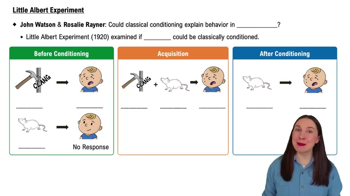
A 1920 study demonstrating that emotional reactions like fear can be learned in humans through association.
John Watson
A psychologist who pioneered research on learned emotional responses in humans using experimental methods.
Rosalie Rayner
A researcher who collaborated on a landmark study showing conditioned fear in a child.
Unconditioned Stimulus
An event that naturally triggers a reflexive reaction without prior learning, such as a loud noise causing fear.
Unconditioned Response
An automatic reaction to a stimulus, like a startled cry in response to a sudden sound.
Neutral Stimulus
An item that initially produces no specific reaction until paired with a meaningful event.
Conditioned Stimulus
An item that, after association with a significant event, elicits a learned reaction on its own.
Conditioned Response
A learned reaction to a previously neutral item, developed through repeated pairings.
Stimulus Generalization
A phenomenon where a learned reaction spreads to items similar to the original trigger.
Acquisition Phase
The period during which repeated pairings of two items lead to the formation of a learned association.
Ethical Considerations
Principles ensuring participant safety and well-being in research, now strictly regulated by review boards.
Institutional Review Board (IRB)
A committee responsible for evaluating research proposals to protect participants from harm.
Artificially Induced Fear
An emotional reaction created in a controlled setting rather than arising from real-life experiences.
 Back
Back
 04:56
04:56