Back

Behaviorism definitions

Control buttons has been changed to "navigation" mode.
1/15
  • Behaviorism

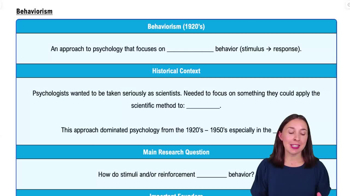
    Psychological approach emphasizing scientific study of observable actions, focusing on measurable responses to environmental stimuli.
  • Observable Behavior

    Actions or responses that can be seen and measured, forming the core focus of scientific psychological study in this approach.
  • Stimulus

    Any external event or cue presented to an organism, used to elicit and study measurable responses.
  • Response

    Measurable action or reaction produced by an organism following exposure to a specific cue or event.
  • Classical Conditioning

    Learning process where a neutral cue becomes associated with a meaningful event, leading to a learned reaction.
  • Operant Conditioning

    Learning process involving modification of actions through consequences like rewards or punishments.
  • Reinforcement

    Consequence that increases the likelihood or frequency of a specific action occurring in the future.
  • Punishment

    Consequence that decreases the likelihood or frequency of a specific action occurring in the future.
  • Scientific Method

    Systematic approach for investigating phenomena, emphasizing measurement, observation, and empirical evidence.
  • Ivan Pavlov

    Russian physiologist whose research with dogs led to the discovery of associative learning through paired cues.
  • John B. Watson

    American psychologist who established this approach as a formal field and applied associative learning principles to humans.
  • B.F. Skinner

    Psychologist who expanded the field by introducing the concept of modifying actions through rewards and punishments.
  • Learning

    Process of acquiring new behaviors or modifying existing ones through experience with environmental cues and consequences.
  • Stimulus-Response Model

    Framework describing how external cues elicit measurable actions, forming the basis for experimental study in this field.
  • Behavior Modification

    Systematic alteration of actions through structured use of rewards and punishments to increase or decrease specific responses.