Behaviorism quiz #3 Flashcards

Behaviorism quiz #3
Control buttons has been changed to "navigation" mode.
1/10
  • What are the three types of behavioral triggers?
    The three types of behavioral triggers are antecedents, behaviors, and consequences.
  • What is the use of reinforcement theory to change human behavior called?
    The use of reinforcement theory to change human behavior is called behavior modification.
  • How does a consequence affect a person's behavior?
    A consequence affects a person's behavior by increasing or decreasing the likelihood that the behavior will occur again.
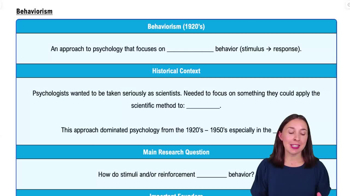
  • Why did early behaviorists believe psychology should focus on observable behavior rather than thoughts or emotions?
    They believed observable behavior could be scientifically measured and studied, unlike thoughts or emotions. This focus aimed to make psychology more respected as a science.
  • What was Ivan Pavlov originally studying when he discovered classical conditioning?
    Pavlov was studying digestion and salivation in dogs. His observations led to the discovery of classical conditioning.
  • How did Pavlov demonstrate the concept of classical conditioning with dogs?
    He paired the sound of a bell with the arrival of food, causing dogs to eventually salivate at the bell alone. This showed that a neutral stimulus could elicit a learned response.
  • What major contribution did John B. Watson make to the field of behaviorism?
    Watson applied classical conditioning principles to human behavior and established behaviorism as a formal field. He emphasized the importance of studying observable actions.
  • How did B.F. Skinner expand upon earlier behaviorist theories?
    Skinner introduced operant conditioning, focusing on how rewards and punishments modify behavior. He emphasized that people can act on their environment, not just react to stimuli.
  • During which decades did behaviorism dominate the field of psychology in the United States?
    Behaviorism dominated from the 1920s through the 1950s. It was especially influential during this period.
  • What was the main research question for behaviorists regarding stimuli and reinforcement?
    They sought to understand how stimuli and reinforcement shape behavior. This involved studying the relationships between environmental events and observable responses.