Back

Cognitive Psychology definitions

Control buttons has been changed to "navigation" mode.
1/15
  • Cognitive Psychology

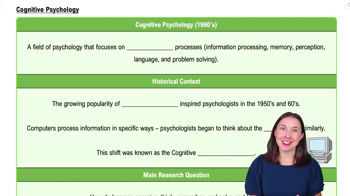
    A field emphasizing mental processes such as perception, memory, and problem-solving, inspired by computer models of information processing.
  • Mental Processes

    Internal activities like thinking, remembering, and perceiving that are central to understanding human experience.
  • Information Processing

    A framework likening the mind to a computer, involving input, storage, and output of data.
  • Perception

    The way sensory information is interpreted and organized to form meaningful experiences.
  • Memory

    The capacity to encode, store, and retrieve information, crucial for learning and daily functioning.
  • Problem Solving

    The mental process of finding solutions to complex or unfamiliar challenges.
  • Language Acquisition

    The process through which humans develop the ability to understand and use language, debated between cognitive and behaviorist views.
  • Cognitive Revolution

    A major shift in psychology during the 1960s, moving focus from behavior to mental processes.
  • Behaviorism

    A psychological approach emphasizing observable actions, criticized for neglecting internal thought.
  • Ulrich Neisser

    A pioneer who defined the field and emphasized the importance of studying internal mental activities.
  • George A. Miller

    A founder known for research on short-term memory capacity, notably the '7 plus or minus 2' concept.
  • Noam Chomsky

    A linguist whose critique of behaviorism reshaped views on language and cognition.
  • Short-Term Memory Capacity

    The limited amount of information, about seven items, that can be held in conscious awareness.
  • Attention

    The cognitive process of selectively focusing on specific information while ignoring others.
  • Linguistics

    The scientific study of language structure, development, and use, closely linked to cognitive psychology.