Cognitive Psychology quiz #6 Flashcards

Cognitive Psychology quiz #6
Control buttons has been changed to "navigation" mode.
1/40
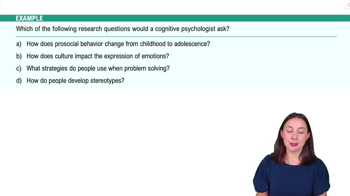
  • What would a cognitive psychologist be interested in?
    A cognitive psychologist would be interested in studying mental processes such as memory, perception, and problem solving.
  • Which perspective emphasizes how we store and retrieve information?
    The cognitive perspective emphasizes storage and retrieval of information.
  • According to researchers, people pay more attention to stimuli that are what?
    People pay more attention to stimuli that are novel, relevant, or emotionally significant.
  • Who is Noam Chomsky and what is his significance in psychology?
    Noam Chomsky is a linguist and cognitive psychologist who challenged behaviorist views on language and contributed to the cognitive revolution.
  • What is the importance of thoughts and internal mental states in psychology?
    Thoughts and internal mental states are important because they influence behavior and are central to cognitive psychology.
  • Both cognitive representation and categorization are types of what?
    They are types of mental processes.
  • Items high on prototypicality have what kind of family resemblances?
    They have strong family resemblances to other members of the category.
  • What is the general function of working memory?
    Working memory temporarily holds and manipulates information for cognitive tasks.
  • What is inattentional blindness?
    Inattentional blindness is failing to notice a visible stimulus because attention is focused elsewhere.
  • What is a mental representation of an actual instance of a member of a category?
    An exemplar is a mental representation of a specific instance within a category.
  • What would most likely be of interest to a theorist from the cognitive approach?
    A theorist from the cognitive approach would be interested in how people perceive, remember, and solve problems.
  • Which perspective is most concerned with how individuals interpret their experiences?
    The cognitive perspective is most concerned with individual interpretation of experiences.
  • What is hindsight bias?
    Hindsight bias is the tendency to believe, after an event has occurred, that one would have predicted or expected the outcome.
  • What type of thought did Vygotsky believe symbolic and make-believe play helped to advance?
    Vygotsky believed it helped advance abstract and higher-order thinking.
  • Which scenario best reflects the basic idea of social constructivism?
    A student learning through collaboration and discussion with peers reflects social constructivism.
  • Which means of comprehending new information best describes a cognitive learner?
    A cognitive learner comprehends new information by actively processing and organizing it.
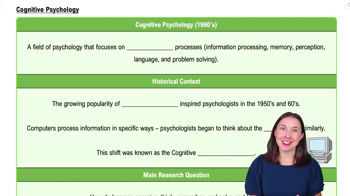
  • What inspired the information processing theory?
    The information processing theory was inspired by knowledge of how computers process information.
  • What is a characteristic feature of information-processing psychologists?
    They use models to describe how information is processed in the mind.
  • What involves knowing about knowing?
    Metacognition involves knowing about knowing.
  • According to your text, what is the key to solving the Wason four-card problem?
    The key is to use logical reasoning to test the validity of a rule.
  • According to cognitive psychologists, what is true?
    Cognitive psychologists believe that mental processes can be studied scientifically.
  • What are mental categories used to group objects, events, and characteristics?
    Concepts are mental categories used for grouping.
  • According to Broadbent, where does the process of rehearsal take place?
    Rehearsal takes place in short-term memory.
  • How can a schema affect memory for items that are out of place?
    A schema may cause someone to forget or misremember items that do not fit expected patterns.
  • The Stroop effect demonstrates people's inability to ignore what aspect of words?
    It demonstrates the inability to ignore the meaning of words.
  • What is an important ability in concrete operational thought?
    An important ability is logical thinking about concrete objects and events.
  • Imagery and repetition are aspects of what?
    They are aspects of memory encoding strategies.
  • Recognizing the meaning of a partially known word in context is an example of what?
    It is an example of using context clues for comprehension.
  • What principle underlies cognitive therapy?
    Cognitive therapy is based on the principle that changing thought patterns can improve emotional well-being.
  • How does a person use the availability heuristic?
    A person uses the availability heuristic by judging the likelihood of events based on how easily examples come to mind.
  • What does cognitive psychology focus on studying?
    Cognitive psychology focuses on studying mental processes such as perception, memory, and problem solving.
  • What is convergence in psychology?
    Convergence refers to the process of narrowing down multiple possibilities to find a single best solution.
  • What principle underlies cognitive-behavioral therapy?
    Cognitive-behavioral therapy is based on the principle that changing thoughts and behaviors can improve psychological health.
  • What is accommodation in cognitive development?
    Accommodation is modifying existing schemas to incorporate new information.
  • Is reading comprehension difficult to assess through formal testing alone?
    Yes, reading comprehension involves complex cognitive processes that may not be fully captured by formal tests.
  • What mental process is required for proficient word reading?
    Proficient word reading requires decoding, which involves recognizing and processing written words.
  • Do most students overestimate their skill level and abilities to take open book tests?
    Yes, many students overestimate their abilities due to overconfidence bias.
  • Can a student with dyslexia also be intellectually gifted?
    Yes, a student with dyslexia can also be intellectually gifted.
  • What is hindsight bias in psychology?
    Hindsight bias is the tendency to see events as having been predictable after they have already occurred.
  • What does breaking down information for quick repetition and memorization mean?
    It means using rote rehearsal or shallow processing.