Skip to main content
Introduction to Psychology
My Course
Learn
Exam Prep
AI Tutor
Study Guides
Flashcards
Explore
Try the app
My Course
Learn
Exam Prep
AI Tutor
Study Guides
Flashcards
Explore
Try the app
Back
Color Vision definitions
You can tap to flip the card.
Trichromatic Theory
You can tap to flip the card.
👆
Trichromatic Theory
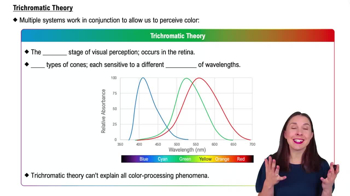
Explains initial color detection in the retina using three cone types sensitive to red, green, and blue wavelengths.
Track progress
Control buttons has been changed to "navigation" mode.
1/15
Related flashcards
Related practice
Recommended videos
Color Vision quiz #1
Color Vision
10 Terms
Color Vision
4. Sensation and Perception
7 problems
Topic
Nicole
Visual Anatomy
4. Sensation and Perception
7 problems
Topic
Nicole
4. Sensation and Perception
3 topics
9 problems
Chapter
Nicole
Guided course
01:48
Trichromatic Theory
928
views
15
rank
Guided course
03:19
Opponent Process Theory
839
views
10
rank
Guided course
02:05
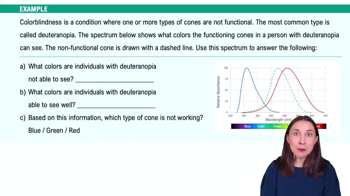
Color Vision Example 1
718
views
14
rank
Terms in this set (15)
Hide definitions
Trichromatic Theory
Explains initial color detection in the retina using three cone types sensitive to red, green, and blue wavelengths.
Opponent-Process Theory
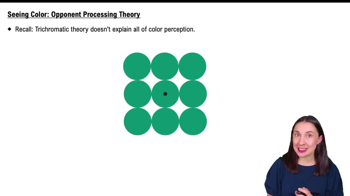
Describes how color pairs are processed by opponent cells in the nervous system, accounting for phenomena like afterimages.
Cone
Photoreceptor in the retina specialized for detecting specific wavelength ranges, enabling color vision.
Retina
Light-sensitive layer at the back of the eye where initial color detection and visual processing begin.
Wavelength
Physical property of light that determines perceived color, with different cones sensitive to specific ranges.
Afterimage
Visual illusion where the complementary color appears after staring at a colored image and then looking away.
Opponent Cell
Neuron in the nervous system that responds to one color in a pair while being suppressed by its opposite.
Visual Cortex
Brain region that interprets neural signals from the eyes, constructing the perception of color.
Color Pair
Set of two colors, such as red-green or blue-yellow, processed in opposition by specific neural mechanisms.
Neural Impulse
Electrical signal transmitted by neurons, underlying the activation and suppression in color processing.
Sensation
Early stage of visual processing involving detection of light and color before interpretation by the brain.
Perception
Process by which the brain organizes and interprets sensory input, resulting in meaningful color experience.
Photoreceptor
Specialized cell in the eye that converts light into neural signals, essential for vision.
Pattern Recognition
Higher-level cognitive process where the brain identifies and interprets visual information beyond basic color.
Visual Field
Total area in which objects can be seen as the eyes focus on a central point.
 BackBack
 01:48
01:48