Skip to main content
Introduction to Psychology
My Course
Learn
Exam Prep
AI Tutor
Study Guides
Flashcards
Explore
Try the app
My Course
Learn
Exam Prep
AI Tutor
Study Guides
Flashcards
Explore
Try the app
Back
Depression definitions
You can tap to flip the card.
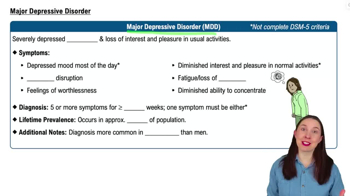
Major Depressive Disorder
You can tap to flip the card.
👆
Major Depressive Disorder
A mood condition marked by persistent sadness and loss of interest, requiring at least five symptoms for over two weeks.
Track progress
Control buttons has been changed to "navigation" mode.
1/15
Related flashcards
Related practice
Recommended videos
Depression quiz #1
Depression
10 Terms
Depression
14. Psychological Disorders
7 problems
Topic
Schizophrenia
14. Psychological Disorders
7 problems
Topic
14. Psychological Disorders
5 topics
11 problems
Chapter
Nicole
Guided course
3:35
Major Depressive Disorder
421
views
4
rank
Guided course
04:03
Biology of Depression
321
views
2
rank
Guided course
01:12
Example 3
245
views
2
rank
Terms in this set (15)
Hide definitions
Major Depressive Disorder
A mood condition marked by persistent sadness and loss of interest, requiring at least five symptoms for over two weeks.
Anhedonia
A loss of pleasure or interest in activities that were once enjoyable, often seen as a core feature of depression.
Persistent Depressive Disorder
A chronic mood disturbance lasting at least two years with milder symptoms, never reaching a full major depressive episode.
Double Depression
A condition where chronic low mood is punctuated by one or more episodes of major depression within a two-year period.
Seasonal Affective Disorder
A depressive pattern linked to seasonal changes, most commonly emerging during fall and winter due to reduced sunlight.
Perinatal Depression
A depressive episode occurring during pregnancy or after childbirth, influenced by hormonal and life changes.
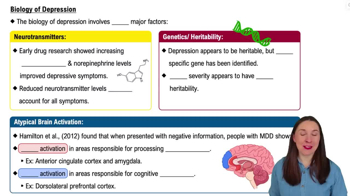
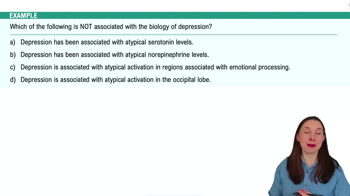
Serotonin
A neurotransmitter whose low levels are associated with depressive symptoms and targeted by many antidepressant treatments.
Norepinephrine
A neurotransmitter involved in mood regulation, with decreased levels linked to depressive states.
Heritability
The proportion of depression risk attributed to genetic factors, with higher rates seen in chronic or severe cases.
Anterior Cingulate Cortex
A brain region showing increased activation during emotional processing in depression, especially with negative information.
Amygdala
A brain structure involved in emotion, often displaying heightened activity in individuals experiencing depression.
Dorsolateral Prefrontal Cortex
A brain area linked to cognitive control, typically underactive in depression when processing negative stimuli.
Negative Schema
A cognitive bias leading to persistent negative thoughts about oneself, the world, and the future in depression.
Attribution Style
A habitual way of explaining negative events as internal, global, and stable, contributing to depressive thinking.
Helplessness Theory
A model proposing that depression is maintained by attributing negative events to personal, pervasive, and unchangeable causes.
 BackBack
 3:35
3:35