Skip to main content
Introduction to Psychology
My Course
Learn
Exam Prep
AI Tutor
Study Guides
Flashcards
Explore
Try the app
My Course
Learn
Exam Prep
AI Tutor
Study Guides
Flashcards
Explore
Try the app
Back
Group Behavior quiz
You can tap to flip the card.
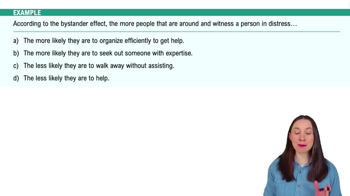
What is the bystander effect?
You can tap to flip the card.
👆
What is the bystander effect?
The bystander effect is the phenomenon where individuals are less likely to help in emergencies when others are present.
Track progress
Control buttons has been changed to "navigation" mode.
1/15
Related flashcards
Related practice
Recommended videos
Group Behavior definitions
Group Behavior
15 Terms
Group Behavior
12. Social Psychology
7 problems
Topic
Nicole
Cognitive Dissonance
12. Social Psychology
7 problems
Topic
Nicole
12. Social Psychology - Part 1 of 2
3 topics
9 problems
Chapter
Nicole
12. Social Psychology - Part 2 of 2
3 topics
9 problems
Chapter
Nicole
Guided course
02:29
Deindividuation
283
views
4
rank
Guided course
01:03
Example 1
271
views
1
rank
Guided course
01:33
Example 2
279
views
4
rank
Terms in this set (15)
Hide definitions
What is the bystander effect?
The bystander effect is the phenomenon where individuals are less likely to help in emergencies when others are present.
What psychological concept explains why people feel less responsible to help when in a group?
Diffusion of responsibility explains why people feel less responsible to help when others are present.
How did the Kitty Genovese case influence psychology?
The Kitty Genovese case sparked interest in studying the bystander effect, even though initial reports were exaggerated.
In what type of situations is the bystander effect less likely to occur?
The bystander effect is less likely in clear and unambiguous emergencies.
How does expertise affect the likelihood of helping in emergencies?
People with relevant expertise are more likely to intervene and help in emergencies.
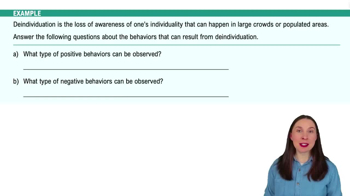
What is deindividuation?
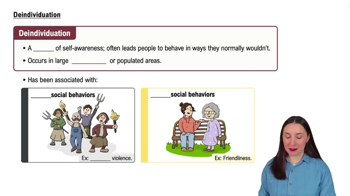
Deindividuation is a loss of self-awareness that can occur in groups, leading people to behave in ways they normally wouldn't.
In what contexts is deindividuation most commonly studied?
Deindividuation is most commonly studied in the context of antisocial behaviors like mob violence.
What is an example of antisocial behavior resulting from deindividuation?
An example is people in a crowd lighting a couch on fire during a celebration, which they wouldn't do alone.
Can deindividuation lead to prosocial behaviors? Give an example.
Yes, deindividuation can lead to increased friendliness, such as striking up conversations with strangers while feeling anonymous.
How does being in a large crowd affect individual behavior according to deindividuation?
Being in a large crowd can cause individuals to lose self-awareness and act in ways they normally wouldn't.
What is meant by 'diffusion of responsibility'?
Diffusion of responsibility is when people in a group feel less personal responsibility to act because they assume others will.
Why might someone not respond to a group email asking for volunteers?
They might wait because they assume others will respond, demonstrating diffusion of responsibility.
Does the bystander effect always occur in emergencies?
No, it does not always occur, especially in clear emergencies or when someone has expertise.
How can anonymity in a new city influence behavior?
Anonymity can make people feel freer and more likely to engage in friendly behaviors with strangers.
Why is understanding group behavior important in psychology?
It helps explain how group dynamics influence individual actions in various social contexts.
 BackBack
 02:29
02:29