Skip to main content
Introduction to Psychology
My Course
Learn
Exam Prep
AI Tutor
Study Guides
Flashcards
Explore
Try the app
My Course
Learn
Exam Prep
AI Tutor
Study Guides
Flashcards
Explore
Try the app
Back
Prevalence and Comorbidity definitions
You can tap to flip the card.
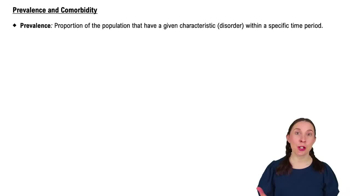
Prevalence
You can tap to flip the card.
👆
Prevalence
Proportion of a population with a specific disorder during a defined time period, crucial for understanding mental health trends.
Track progress
Control buttons has been changed to "navigation" mode.
1/14
Related flashcards
Related practice
Recommended videos
Prevalence and Comorbidity quiz #1
Prevalence and Comorbidity
10 Terms
Prevalence and Comorbidity
14. Psychological Disorders
7 problems
Topic
Depression
14. Psychological Disorders
7 problems
Topic
14. Psychological Disorders
5 topics
11 problems
Chapter
Nicole
Guided course
01:08
Example 1
370
views
1
rank
Guided course
04:18
Prevalence and Comorbidity
428
views
4
rank
Terms in this set (14)
Hide definitions
Prevalence
Proportion of a population with a specific disorder during a defined time period, crucial for understanding mental health trends.
Point Prevalence
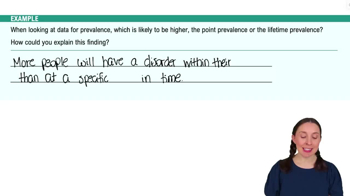
Percentage of individuals with a disorder at a specific moment, reflecting current cases within a population.
Lifetime Prevalence
Percentage of individuals who have ever had a disorder at any time in their lives, offering a broader view than current rates.
Comorbidity
Simultaneous presence of two or more disorders in one person, often leading to more severe symptoms and outcomes.
Diagnosis
Professional identification of a disorder based on established criteria, essential for prevalence and comorbidity statistics.
Anxiety Disorder
Broad category encompassing multiple diagnoses characterized by excessive fear or worry, often measured in prevalence studies.
Major Depression
Mood disorder marked by persistent sadness and loss of interest, frequently cited in prevalence and comorbidity data.
PTSD
Condition triggered by traumatic events, commonly comorbid with depression and measured in mental health surveys.
Autism Spectrum Disorder
Neurodevelopmental condition with social and communication challenges, often comorbid with ADHD.
ADHD
Neurodevelopmental disorder involving inattention, hyperactivity, and impulsivity, frequently comorbid with autism spectrum disorder.
Substance Abuse
Pattern of harmful use of psychoactive substances, commonly co-occurring with depression in clinical samples.
Outcome
Resulting impact on functioning and quality of life, often worsened by the presence of comorbid disorders.
Sample
Group of individuals studied to determine prevalence or comorbidity rates, influencing reported statistics.
National Institute of Mental Health
U.S. agency conducting large-scale surveys to provide data on mental health disorder rates and trends.
 BackBack
 01:08
01:08