 Back
Inductive and Deductive Reasoning, Estimation, and Problem Solving – Quantitative Reasoning Study Guide
Study Guide - Smart Notes
 Tailored notes based on your materials, expanded with key definitions, examples, and context.
Q1. Mira does her laundry once a week. For the last three weeks, she did it on Saturday. What day will she do her laundry next week?
Background
Topic: Inductive Reasoning
This question tests your ability to use specific examples to make a general conjecture and predict future events.

Key Terms:
Inductive Reasoning: Drawing general conclusions from specific examples.
Conjecture: An educated guess based on observed patterns.
Step-by-Step Guidance
Identify the pattern in the specific examples: Mira did laundry on Saturday for three consecutive weeks.
Formulate a conjecture based on the pattern: If the pattern continues, what day would you expect Mira to do laundry next week?
Use the conjecture to make a prediction about the next occurrence.
Try solving on your own before revealing the answer!
Final Answer: Saturday
Based on the observed pattern, the conjecture is that Mira does her laundry on Saturday. Therefore, she will likely do her laundry next week on Saturday.
Q2. Find the next two numbers in the pattern:
Background
Topic: Inductive Reasoning & Number Patterns
This question tests your ability to recognize and extend a numerical pattern using inductive reasoning.

Key Terms and Formulas:
Pattern: A repeated or predictable sequence.
Inductive Reasoning: Using observed values to predict the next values.
Step-by-Step Guidance
Examine the sequence and look for a pattern in the numerators and denominators.
Notice that the denominators are consistently 4, while the numerators increase by 1 each time.
Write the next two terms by continuing the pattern of increasing the numerator by 1.
Try solving on your own before revealing the answer!
Final Answer:
The next two numbers are and , following the pattern of increasing the numerator by 1 each time.
Q3. Find the next figure in the pattern (nested squares).
Background
Topic: Inductive Reasoning & Visual Patterns
This question tests your ability to recognize and extend a geometric pattern using inductive reasoning.



Key Terms:
Pattern: A repeated arrangement of shapes.
Inductive Reasoning: Using observed figures to predict the next figure.
Step-by-Step Guidance
Observe the sequence of figures and count the number of nested squares in each.
Notice the color alternation and the addition of a new square with each step.
Predict what the next figure will look like based on the pattern.
Try solving on your own before revealing the answer!
Final Answer: Four nested squares, alternating colors
The next figure will have four nested squares, continuing the color alternation and pattern of adding a new square each time.
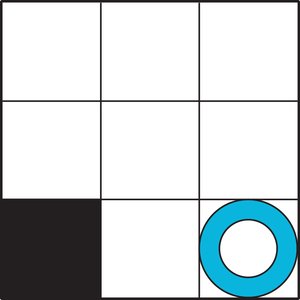
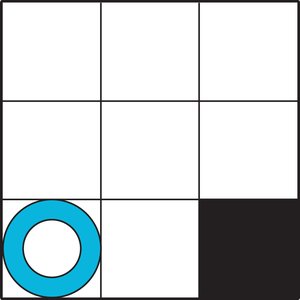
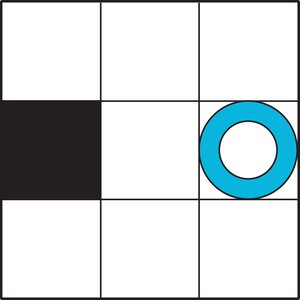
Q4. Use inductive reasoning to find the next figure in the pattern (grid with colored squares and circles).
Background
Topic: Inductive Reasoning & Visual Patterns
This question tests your ability to recognize and extend a pattern involving positions and colors in a grid.

Key Terms:
Pattern: Arrangement of shapes and colors in a grid.
Inductive Reasoning: Using observed figures to predict the next figure.
Step-by-Step Guidance
Observe the position of the colored square and circle in each grid.
Identify the movement or change in position from one figure to the next.
Predict the next position based on the established pattern.
Try solving on your own before revealing the answer!
Final Answer: The next figure will have the colored square and circle in the next logical positions based on the pattern.
Continue the movement pattern to determine the next arrangement in the grid.
Q5. Explain the difference between inductive and deductive reasoning.
Background
Topic: Inductive vs. Deductive Reasoning
This question tests your understanding of the two main types of logical reasoning used in quantitative reasoning.
Key Terms:
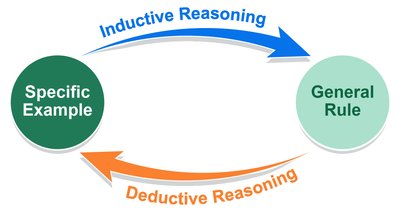
Inductive Reasoning: Using specific examples to form general rules.
Deductive Reasoning: Using general rules to draw conclusions about specific cases.
Step-by-Step Guidance
Define inductive reasoning and provide an example.
Define deductive reasoning and provide an example.
Compare the direction of reasoning (specific to general vs. general to specific).
Try solving on your own before revealing the answer!
Final Answer: Inductive reasoning moves from specific examples to general rules, while deductive reasoning moves from general rules to specific conclusions.
Inductive reasoning is used to form hypotheses, while deductive reasoning is used to test them.
