Skip to main content
Introduction to Sociology
My Course
Learn
AI Tutor
Study Guides
Flashcards
Explore
Try the app
My Course
Learn
AI Tutor
Study Guides
Flashcards
Explore
Try the app
Back
The Effect of Groups definitions
You can tap to flip the card.
Conformity
You can tap to flip the card.
👆
Conformity
A shift in behaviors, attitudes, or beliefs to align with those of a group, even when evidence contradicts the group’s stance.
Track progress
Control buttons has been changed to "navigation" mode.
1/15
Related flashcards
Recommended videos
The Effect of Groups quiz
The Effect of Groups
15 Terms
Guided course
02:35
Conformity
66
views
1
rank
Guided course
04:34
Obedience
63
views
1
rank
Guided course
03:15
Groupthink
66
views
Terms in this set (15)
Hide definitions
Conformity
A shift in behaviors, attitudes, or beliefs to align with those of a group, even when evidence contradicts the group’s stance.
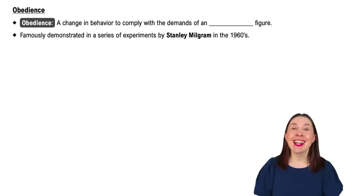
Obedience
A behavioral change resulting from compliance with the demands of an authority figure, often overriding personal morals.
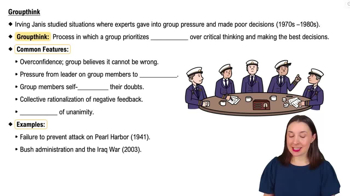
Groupthink
A process where group harmony and agreement are prioritized over critical analysis, often leading to flawed decisions.
Bystander Effect
A phenomenon where the presence of others reduces the likelihood that any individual will help someone in need.
Diffusion of Responsibility
A psychological state where individuals feel less personal obligation to act when others are present.
Authority Figure
An individual perceived as having power or control, whose directives strongly influence others’ actions.
Confederate
A person secretly working with the experimenter, posing as a participant to influence the study’s outcome.
Self-Censorship
The act of withholding doubts or dissenting opinions within a group to maintain perceived consensus.
Collective Rationalization
A group’s tendency to dismiss warnings or negative feedback, reinforcing their shared beliefs.
Overconfidence
An inflated belief within a group that their decisions are infallible, often ignoring contrary evidence.
Illusion of Unanimity
A false sense that everyone in a group agrees, often masking private doubts or disagreements.
Social Influence
The impact that others have on an individual’s thoughts, feelings, or behaviors within a group context.
Confirmation Bias
A tendency to favor information that supports existing beliefs, often seen in group decision-making.
Experimental Design
A structured procedure in research, such as Asch’s or Milgram’s studies, to systematically test social phenomena.
Moral Distress
Emotional discomfort experienced when actions conflict with personal ethical standards, as seen in obedience studies.
 BackBack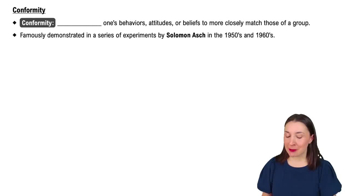
 02:35
02:35