What is the main idea of the functionalist perspective on deviance?
The functionalist perspective sees deviance as a normal and necessary part of society that clarifies social boundaries and promotes social cohesion or change.
According to Durkheim, what are the four functions of deviance?
Durkheim's four functions are affirming societal values, defining social boundaries, increasing social cohesion, and promoting social change if society agrees with the deviance.
How does society's agreement or disagreement with deviance affect its functions, according to Durkheim?
If society disagrees, deviance reinforces norms and cohesion; if society agrees, deviance can lead to informal or formal social change.
What is Merton's strain theory of deviance?
Strain theory posits that deviance occurs when individuals lack access to conventional means to achieve societal goals, leading to various responses like conformity, innovation, ritualism, retreatism, or rebellion.
What is the difference between innovation and ritualism in Merton's strain theory?
Innovation involves accepting societal goals but rejecting conventional means, while ritualism involves rejecting the goals but continuing to follow the means.
How does retreatism differ from rebellion in Merton's strain theory?
Retreatism is rejecting both societal goals and means without creating new ones, while rebellion involves creating new, unconventional goals and means.
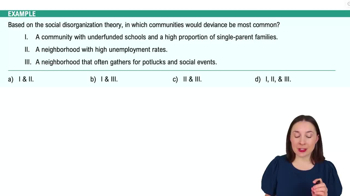
What does social disorganization theory say about the causes of deviance?
Social disorganization theory argues that deviance results from weak social ties and lack of social control in a person's environment, especially in communities with poverty and family disruption.
How do weak social ties contribute to deviance according to social disorganization theory?
Weak social ties at the family or community level reduce informal and formal social control, making deviance more likely.
What is the main focus of conflict theory regarding deviance?
Conflict theory emphasizes that deviance is shaped by power inequalities, with laws and sanctions often protecting those in power and punishing low-power individuals more harshly.
How do deviant labels affect low-power versus high-power individuals according to conflict theory?
Deviant labels have a larger negative impact on low-power individuals, affecting their access to resources, while high-power individuals often face less severe consequences.
What types of crime are associated with high-power individuals in conflict theory?
High-power individuals are often associated with white collar crime, organized crime, and hate crime, which historically have been punished less harshly than street crimes.
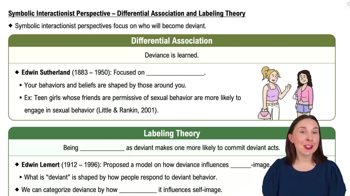
What is the main idea of differential association theory?
Differential association theory states that deviance is a learned behavior, acquired through socialization and association with others who engage in deviant acts.
According to labeling theory, how does being labeled as deviant affect a person?
Being labeled as deviant can change a person's self-image, making them more likely to commit deviant acts in the future, especially if the label becomes their master status.
What is the difference between primary and secondary deviance in labeling theory?
Primary deviance involves minor acts with little impact on self-image, while secondary deviance involves more serious acts that strongly affect self-image and may lead to stigma.
What are the four types of social bonds in social bond theory, and how do they relate to deviance?
The four types are attachment, commitment, involvement, and belief; strong social bonds reduce the likelihood of deviance, while weak bonds increase it.
 Back
Back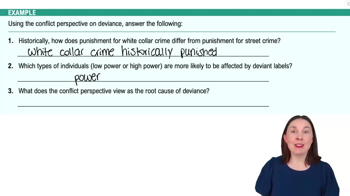
 01:15
01:15