Skip to main content
Introductory Statistics
My Course
Learn
Exam Prep
AI Tutor
Study Guides
Textbook Solutions
Flashcards
Explore
Try the app
My Course
Learn
Exam Prep
AI Tutor
Study Guides
Textbook Solutions
Flashcards
Explore
Try the app
Back
Contingency Tables definitions
You can tap to flip the card.
Contingency Table
You can tap to flip the card.
👆
Contingency Table
A matrix displaying frequencies for two categorical variables, enabling analysis of their relationship and calculation of expected values.
Track progress
Control buttons has been changed to "navigation" mode.
1/15
Related flashcards
Related practice
Recommended videos
Contingency Tables quiz #1
Contingency Tables
10 Terms
Introduction to Contingency Tables
13. Chi-Square Tests & Goodness of Fit
3 problems
Topic
Chi Square Test for Independence
13. Chi-Square Tests & Goodness of Fit
3 problems
Topic
13. Chi-Square Tests & Goodness of Fit
4 topics
5 problems
Chapter
Guided course
08:18
Contingency Tables & Expected Frequencies
796
views
10
rank
1
comments
Terms in this set (15)
Hide definitions
Contingency Table
A matrix displaying frequencies for two categorical variables, enabling analysis of their relationship and calculation of expected values.
Categorical Variable
A data type representing distinct groups or categories, such as grade levels or height ranges, used in frequency analysis.
Observed Frequency
The actual count recorded in each cell of a table, reflecting the real data collected for specific category combinations.
Expected Frequency
A calculated value predicting the count in a cell, assuming the variables are independent, based on row and column totals.
Independence
A condition where the occurrence of one variable does not affect the probability of the other, crucial for expected frequency calculations.
Row Total
The sum of frequencies across a row, representing the total count for a specific category of one variable.
Column Total
The sum of frequencies down a column, indicating the total count for a specific category of the second variable.
Grand Total
The overall sum of all frequencies in a table, representing the total sample size analyzed.
Cell
An intersection point in a table where a specific combination of categories from two variables is recorded.
Joint Probability
The likelihood of simultaneously observing two specific categories, calculated by multiplying their individual probabilities.
Frequency Distribution
A summary showing how often each category or combination occurs, extended to two variables in contingency tables.
Subtotal
A partial sum provided for rows or columns, aiding in quick calculation of totals within a table.
Sample Size
The total number of data points or individuals included in the analysis, forming the basis for frequency calculations.
Category
A distinct group or classification within a variable, such as height range or grade level, used for organizing data.
E Value
A shorthand for expected frequency in a cell, derived from the formula involving row, column, and grand totals.
 BackBack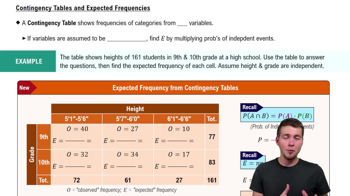
 08:18
08:18