What is the role of critical values in hypothesis testing?
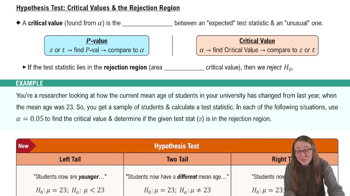
Critical values act as thresholds that separate expected test statistics from unusual ones, defining rejection regions where the null hypothesis is rejected if the test statistic falls within them.
How do you find a critical value for a left-tail hypothesis test?
For a left-tail test, the critical value is the z-score with alpha as its left tail probability, found using a z table or technology.
What is the rejection region in a left-tail hypothesis test?
The rejection region is the area to the left of the critical value, with probability equal to alpha.
How do you decide to reject the null hypothesis using the critical value method?
If the test statistic falls within the rejection region defined by the critical value, you reject the null hypothesis.
What is the critical value for a right-tail hypothesis test with alpha = 0.05?
The critical value is 1.64, which is the z-score with 0.05 as its right tail probability.
How is the rejection region defined in a right-tail hypothesis test?
The rejection region is the area to the right of the critical value, with probability equal to alpha.
What are the critical values for a two-tailed hypothesis test with alpha = 0.05?
The critical values are -1.96 and 1.96, corresponding to alpha/2 = 0.025 in each tail.
How do you determine the rejection region in a two-tailed hypothesis test?
The rejection region consists of both tails beyond the critical values, with each tail having an area of alpha/2.
What is the main difference between the p-value method and the critical value method?
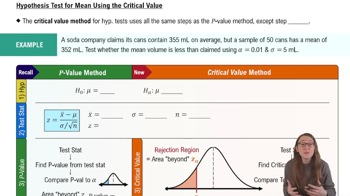
The p-value method compares the p-value to alpha, while the critical value method compares the test statistic directly to the critical value(s).
How do you calculate the test statistic in a hypothesis test?
The test statistic is calculated using the formula (sample mean - population mean) divided by (population standard deviation divided by the square root of sample size).
What is the critical value for a left-tail test with alpha = 0.01?
The critical value is approximately -2.33, which is the z-score with 0.01 as its left tail probability.
What conclusion do you draw if the test statistic is in the rejection region?
If the test statistic is in the rejection region, you reject the null hypothesis, indicating evidence for the alternative hypothesis.
What criteria must be met to ensure valid conclusions in hypothesis testing?
The sample must be normally distributed or the sample size must be greater than 30 to ensure valid conclusions.
How do you write hypotheses for a hypothesis test?
The null hypothesis states the expected value (e.g., mu = 355), and the alternative hypothesis states the value being tested (e.g., mu < 355).
What does it mean if the p-value is less than alpha in hypothesis testing?
If the p-value is less than alpha, you reject the null hypothesis, indicating significant evidence against it.