Back

Link Between Confidence Intervals and Hypothesis Testing quiz

Control buttons has been changed to "navigation" mode.
1/15
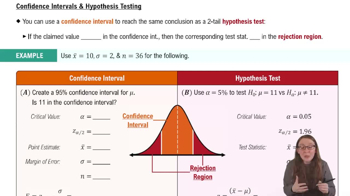
  • What does it mean if the claimed population mean is not within the 95% confidence interval?

    It means we reject the null hypothesis and conclude the claimed mean is unlikely to be true.
  • What is the critical value zα/2 for a 95% confidence interval?

    The critical value zα/2 for a 95% confidence interval is 1.96.
  • How do you calculate alpha for a 95% confidence interval?

    Alpha is calculated as 1 minus the confidence level, so for 95%, alpha is 0.05.
  • What is the formula for pose the margin of error (E) in a confidence interval for the mean?

    The margin of error E is calculated as zα/2 times sigma divided by the square root of n.
  • If the test statistic falls in the rejection region during a hypothesis test, what is the conclusion?

    We reject the null hypothesis if the test statistic falls in the rejection region.
  • What are the null and alternative hypotheses in a two-tailed test for a population mean?

    The null hypothesis is that mu equals the claimed value, and the alternative is that mu does not equal the claimed value.
  • How do you determine the rejection regions for a two-tailed hypothesis test at alpha = 0.05?

    The rejection regions are to the left of -1.96 and to the right of 1.96 on the z-distribution.
  • What is the test statistic formula for testing a population mean with commonly known sigma?

    The test statistic is (sample mean - claimed mean) divided by (sigma divided by the square root of n).
  • What does it mean if the claimed value is entirely above the confidence interval in a left-tailed test?

    It means we reject the null hypothesis in a left-tailed test.
  • What does it mean if the claimed value is entirely below the confidence interval in a right-tailed test?

    It means we reject the null hypothesis in a right-tailed test.
  • Why do confidence intervals and hypothesis tests often lead to the same conclusion for population means?

    Because both methods use the same data and critical values to assess the plausibility of the claimed mean.
  • What is the sample mean (x̄) used for in constructing a confidence interval?

    The sample mean is the point estimate for the population mean in the confidence interval formula.
  • Why must we be careful when using confidence intervals to test claims about a population proportion (p)?

    Because confidence intervals for proportions do not always align perfectly with hypothesis test results.
  • What is the conclusion if the claimed mean is inside the confidence interval?

    We do not reject the null hypothesis and the claimed mean is considered plausible.
  • How does the confidence level relate to the probability of Type I error (alpha)?

    The confidence level is 1 minus alpha, so a higher confidence level means a lower probability of Type I error.