Statistics
My Course
Learn
Exam Prep
AI Tutor
Study Guides
Textbook Solutions
Flashcards
Explore
My Course
Learn
Exam Prep
AI Tutor
Study Guides
Textbook Solutions
Flashcards
Explore
Back
Link Between Confidence Intervals and Hypothesis Testing definitions
You can tap to flip the card.
Define:
Confidence Interval
You can tap to flip the card.
š
Confidence Interval
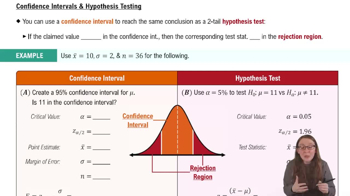
A range of values calculated from sample data that likely contains the true population parameter with a specified probability.
Track progress
Control buttons has been changed to "navigation" mode.
1/15
Related flashcards
Related practice
Recommended videos
Link Between Confidence Intervals and Hypothesis Testing quiz
Link Between Confidence Intervals and Hypothesis Testing
15 Terms
9. Hypothesis Testing for One Sample
1 topic
3 problems
Chapter
David-Paige
Guided course
05:36
Link Between Confidence Intervals and Hypothesis Testing
Patrick
140
views
Terms in this set (15)
Hide definitions
Confidence Interval
A range of values calculated from sample data that likely contains the true population parameter with a specified probability.
Hypothesis Test
A statistical procedure used to evaluate claims about a population parameter by analyzing sample data.
Population Mean
The average value of all members in a population, often denoted by the Greek letter mu.
Null Hypothesis
An initial assumption about a population parameter, typically stating no effect or no difference.
Alternative Hypothesis
A statement that contradicts the null hypothesis, suggesting a different value or relationship.
Critical Value
A threshold from statistical tables used to determine the boundaries of the rejection region in hypothesis testing.
Rejection Region
The area in the distribution where the test statistic leads to rejecting the null hypothesis.
Test Statistic
A value calculated from sample data used to decide whether to reject the null hypothesis.
Margin of Error
The amount added and subtracted from the point estimate to create a confidence interval.
Alpha
The probability of making a Type I error, representing the significance level in hypothesis testing.
Z Table
A reference chart listing probabilities and critical values for the standard normal distribution.
Point Estimate
A single value derived from sample data used to approximate a population parameter.
Two-Tailed Test
A hypothesis test where the rejection region is split between both ends of the distribution.
Population Standard Deviation
A measure of variability for all members in a population, denoted by the Greek letter sigma.
Population Proportion
The fraction or percentage of a population exhibiting a certain characteristic, denoted by p.